
SoundLegal AI: Domain-Specific Legal Intelligence for Music & Entertainment Contracts
Abstract
Entertainment contracts are notoriously complex, often causing creators to unwittingly sign away rights and income. SoundLegal AI is a first-of-its-kind legal AI assistant tailored specifically to the music and entertainment industry. Unlike generic large language model (LLM) tools, SoundLegal is built on a proprietary corpus of music contracts and lawyer-trained domain models, delivering instant clause-by-clause analysis in plain English. In addition to analysis, SoundLegal supports agreement creation, generating structured first drafts of common entertainment agreements from guided inputs, with plain-English explanations and consistency checks designed for real deal workflows. This whitepaper presents SoundLegal’s vision and technology: a high-level architecture of its AI platform, key functional modules, and the entertainment-specific intelligence that sets it apart. We demonstrate through use cases how SoundLegal provides creators and industry professionals with contract clarity, risk flagging, and actionable insights that were previously accessible only via expensive legal counsel, while accelerating drafting for routine agreements. We also discuss the ethical guardrails and human oversight baked into the system to ensure reliable and responsible deployment. Finally, we position SoundLegal in the market context, illustrating its differentiation from generic AI chatbots and traditional legal services, and outline our roadmap toward broader impact. SoundLegal emerges as the first AI legal assistant for music and entertainment, combining academic-level AI rigor with business-savvy usability to empower creators and invite collaboration from investors and industry stakeholders.
Introduction: The Industry Problem
In the music and entertainment industry, contracts often read like a foreign language to the very artists and creators expected to sign them. Complex legal jargon, hidden clauses, and opaque terms routinely lead to artists unknowingly signing away rights or revenues. High-profile disputes—from legacy acts fighting for their master recordings decades later to new artists trapped in onerous “360” deals—underscore a systemic problem: creators lack accessible, affordable legal insight at the moment of signing.
Traditionally, a musician’s choices are stark: sign blind (risking their career on what they don’t know) or hire an entertainment lawyer at $300–$500/hour, which many cannot afford. Even those who can engage lawyers face delays—waiting days or weeks for contract review—during which opportunities might slip away. The result is a persistent gap between how contracts are written and how creators understand them. In 2025, despite advances in legal tech, independent artists still largely navigate contracts without expert guidance, leading to mistakes that can “make or break an artist’s career”.
Generic AI chatbots have recently emerged as a tempting shortcut, but they are ill-suited for legal nuance. A general AI might provide a superficial summary of a recording contract, yet miss critical industry-specific implications or even invent false assurances (a known AI “hallucination” risk). The margin for error in legal matters is zero—“good enough” is dangerous. For example, a creator asking a generic AI to review a contract might get a confident-sounding reply that completely overlooks a rights reversion clause or misinterprets a royalty formula. Such oversights or inaccuracies can cost an artist their masters or years of income.
This is the problem SoundLegal AI was built to solve. SoundLegal was founded on the mission to democratize contract understanding for creators – to provide the clarity of a top entertainment lawyer, on demand, at a fraction of the cost. By focusing AI specifically on music and entertainment contracts (and training it with real music lawyers in the loop), SoundLegal delivers the depth of insight that generic tools cannot. The goal is simple but transformative: empower musicians, producers, songwriters, and other creatives to sign deals with eyes wide open, armed with knowledge previously out of reach. In the following sections, we introduce how SoundLegal’s platform achieves this through a blend of proprietary AI technology, domain-specific intelligence, and human-guided design.
System Overview: SoundLegal’s AI Architecture (High-Level)
SoundLegal’s platform is a proprietary, end-to-end AI system purpose-built for contract analysis in entertainment. At a high level, the architecture can be summarized as an LLM-centered pipeline augmented with domain-specific data and legal expert feedback.
In contrast to “LLM wrapper” apps that simply pass prompts to a generic model, SoundLegal’s architecture incorporates multiple specialized components working in concert (Figure 1):
Figure 1: High-level architecture of the SoundLegal AI platform, illustrating the flow from user contract input to AI analysis and output insights. The system combines general NLP capabilities with entertainment-specific legal logic at each stage.
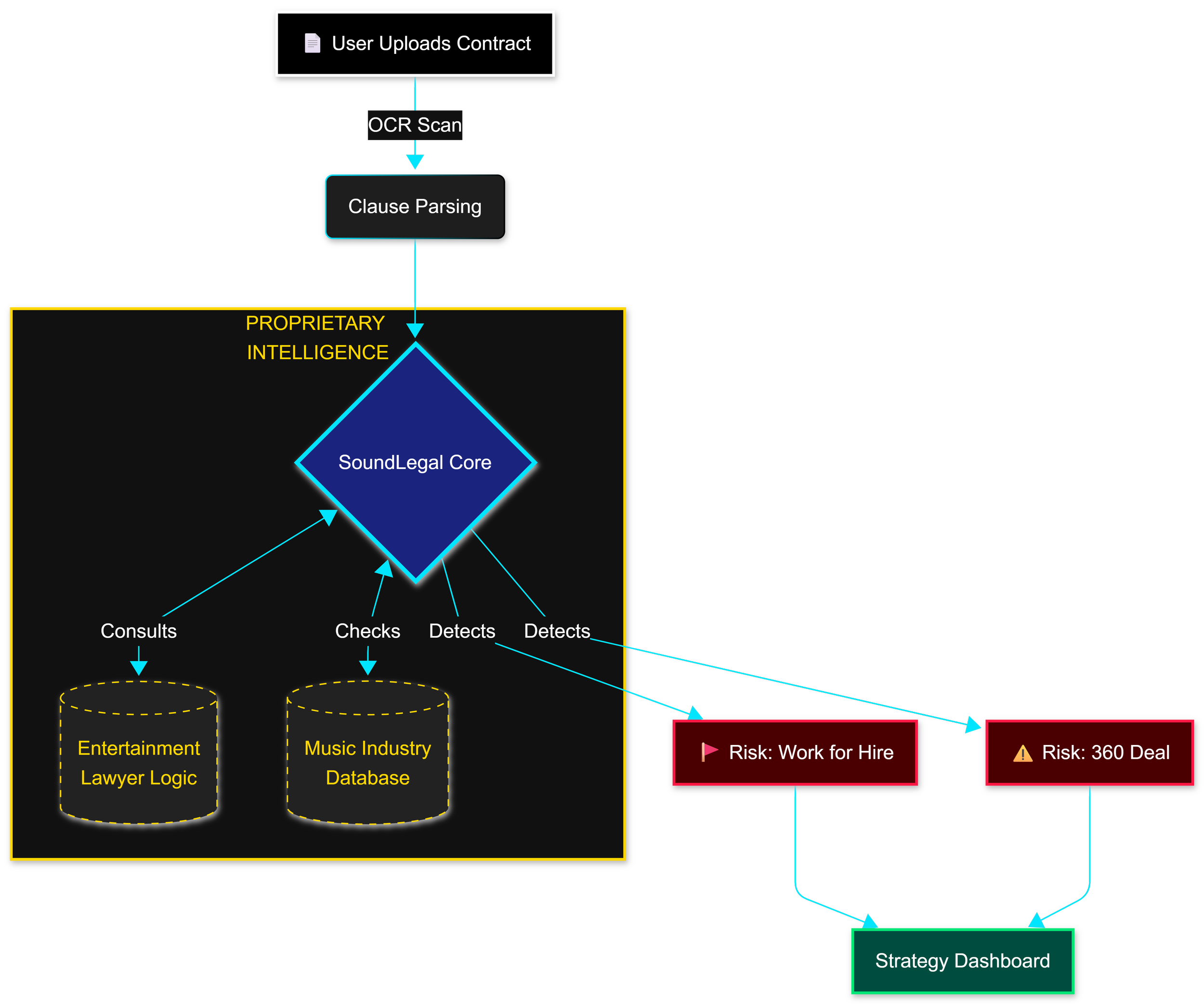
Document Ingestion & Parsing: Users begin by uploading a contract (in PDF, DOC, or image form). The platform includes an ingestion module that handles OCR (Optical Character Recognition) for scanned documents and PDF parsing, converting the contract into text. The text is then segmented into logical sections or clauses.
Clause Segmentation & Classification: The contract is automatically broken down clause-by-clause and each clause is classified by type (e.g. grant of rights, payment terms, exclusivity, etc.). This step uses a combination of regex rules and machine learning classifiers trained on entertainment contract data to identify important sections. By structuring the contract into digestible pieces, the system can apply targeted analysis to each part.
Entertainment LLM Analysis: At the core of SoundLegal is a custom large language model, fine-tuned specifically on entertainment law text. This AI engine was initially built on a state-of-the-art LLM, then rigorously retrained on hundreds of real music and film contracts, legal annotations, and industry-specific terms. When a new contract is analyzed, the model processes each clause’s text along with its context (contract type, parties, etc.), and draws upon its specialized knowledge to interpret meaning and significance. Because the model was trained “a mile deep” on music law rather than a mile wide on generic internet text, it understands nuances like a “sunset clause” in a management deal (continuing post-termination commissions) or what “360 rights” entail, without needing explicit explanation. This domain focus yields higher accuracy on contract tasks – consistent with research showing legal-specific LLMs outperform general LLMs on nuanced legal understanding.
Embedded Legal Logic & Knowledge Base: Beyond the pure neural model, SoundLegal embeds a layer of legal reasoning rules and a knowledge database. This includes a repository of common clause patterns, legal definitions, and best-practice checklists provided by entertainment attorneys. For example, if the model identifies a royalty clause, the system cross-references a knowledge base of typical royalty rates and audit rights. If a clause mentions “work for hire” or “in perpetuity”, the engine recognizes these as red-flag terms (from its rule-base) and triggers special handling to highlight risks. This hybrid approach – combining AI with coded expert logic – ensures that critical industry-specific issues are not only caught, but assessed in line with how a seasoned lawyer would approach them. The legal knowledge base is continuously updated; as new laws or industry contract standards emerge, SoundLegal’s developers (with legal experts) update the rules and training data, keeping the AI’s advice current.
Output Synthesis & User Interface: Finally, SoundLegal synthesizes the analysis into human-friendly outputs. The system assembles a report that maps each original clause to a plain-English explanation and an actionable insight. Key terms (like rights granted, durations, royalty percentages) are extracted and presented in summaries or even in table form for clarity. Risky clauses are prepended with warning icons or labels (e.g. “⚠️ Work for Hire – You would waive future ownership of these recordings”) and specific recommendations (e.g. “Consider negotiating a termination provision or a royalty audit clause”). Crucially, the output is not just a dry summary, but a contextual advisory: SoundLegal will not only translate legalese, but also tell the user “what this means for you” and “what you might do about it”. The results are delivered via a web-based dashboard that is accessible to non-lawyers. Users can click on highlighted sections of the uploaded contract to see SoundLegal’s explanation side-by-side, or jump to a generated contract summary and Q&A section. This intuitive UX means that even a first-time user—say an indie musician with no legal background—can navigate their contract’s story with ease.
Performance and Scalability: SoundLegal’s architecture is optimized for instant analysis. By leveraging efficient text chunking and parallel processing, the platform can analyze a standard record deal (~20 pages) in under a minute, delivering near-real-time feedback to the user. The underlying AI model runs on cloud-based GPU servers for speed, and the vectorized knowledge retrieval ensures that even large contracts or libraries of contracts can be processed without slow-down. This engineering focus on responsive performance addresses a key need in the field: creators often have limited time to decide on deals, so an AI assistant must work on a human timescale (seconds or minutes, not days).
Importantly, while the above describes the system’s automated pipeline, SoundLegal’s design includes hooks for human review at critical junctures. For example, a particularly unusual or complex clause can be flagged for a “human check” if the AI’s confidence is low. In enterprise scenarios (e.g. a label or law firm using SoundLegal), a lawyer on the team can easily review and adjust the AI’s output via an editor interface, creating a feedback loop that further trains the model. Thus, the architecture isn’t a black box in isolation—it’s a collaborative AI, with human-in-the-loop integration at both training time and (if needed) during deployment.
Alongside analysis, SoundLegal includes an agreement authoring capability for drafting common entertainment agreements. The system collects structured deal inputs (parties, term, territory, rights scope, compensation, deliverables, approvals, termination, and dispute mechanics), composes a first-draft document using a curated clause library, then performs internal consistency validation (definitions, cross-references, dates, and conflicting terms). The draft is paired with a plain-English companion layer that explains each section’s purpose and typical negotiation levers, so creators can understand what they are proposing or signing before professional review.
Functional Modules & User Experience: What SoundLegal Does
From a user’s perspective, SoundLegal delivers a seamless experience that simplifies contract review into a few effortless steps. Below is a walkthrough of the platform’s key functional modules and how users interact with them:
Upload & Input: The user (artist, manager, lawyer, etc.) logs into the SoundLegal web application. The interface immediately offers a prompt to upload a contract file or drag-and-drop it. SoundLegal accepts common formats (PDF, Word, text, and image scans). For instance, an independent musician can upload their new recording contract PDF. The platform then automatically handles text extraction (including OCR for scans) in the background.
Instant AI Analysis: Once the document is uploaded, the user clicks “Analyze”. Within seconds, SoundLegal’s backend pipeline (described in the previous section) parses and analyzes the contract. The user is presented with an interactive analysis dashboard. This typically includes:
Summary of Key Terms: A top-level summary that outlines the deal in plain language – e.g. “This is a 3-album exclusive recording agreement between Artist X and Label Y. The term is 5 years, and the artist is granting ownership of master recordings to the label during that term.” It will list deal highlights like advance amount, royalty percentage, distribution territory, contract term length, etc., if present.
Clause-by-Clause Insights: The contract text is displayed (often on the left side of the screen) with important clauses automatically highlighted. When the user clicks or hovers on a highlight, a sidebar or popup shows SoundLegal’s interpretation and notes for that clause. For example, clicking on the Grant of Rights clause might show: “Rights Granted: You are giving the label exclusive rights to all music recordings you create during the contract term. ⚠️ This means you cannot release music with any other label until the contract ends.” Similarly, a Royalties clause highlight might reveal a breakdown of how royalties are calculated, with any unusual deductions flagged (“The contract mentions ‘packaging deductions’ – SoundLegal notes this reduces your royalty for physical sales by 10%, a point you might negotiate.”).
Risk Alerts and Recommendations: For any clause that could significantly impact the artist’s rights or income, SoundLegal places a “Risk Alert” indicator. These alerts are written in clear, urgent language, often accompanied by guidance. For instance: “⚠️ Exclusivity Clause: This contract prevents you from collaborating with other labels or releasing music independently. Why it matters: You’d be effectively locked into Label Y. Suggestion: Negotiate for a carve-out allowing non-commercial releases or features with other artists.” These insights go beyond mere translation – they provide strategy, mimicking what a friendly lawyer might whisper in the artist’s ear about how to protect themselves.
Negotiation Tips: In addition to flagging issues, SoundLegal often provides negotiation tips or alternatives. E.g., if a contract lacks a reversion clause for master recordings, SoundLegal might note: “No Reversion Clause: The contract does not specify if/when rights to your masters return to you. Typically, artists try to include a clause that reassigns master ownership back to them after X years or upon fulfilling obligations. Consider discussing this with the label.” In this way, the platform empowers creators not just to spot problems but to proactively seek better terms.
Q&A Chat (Beta): For users who have follow-up questions, SoundLegal offers a chat-like interface where they can ask questions about the contract in natural language. For example, “Can the label sell my music to a movie without asking me?” The AI will refer to the sync licensing or rights clauses and answer accordingly: e.g. “Clause 5.2 gives the label the right to license your music for films or commercials without separate approval, meaning yes, they could place your songs in a movie without additional sign-off or payment to you (beyond your royalty).” This interactive module leverages the AI’s understanding and the vectorized contract data to provide on-the-fly explanations, turning the contract into a knowledge base the user can query.
Visualization & Reports: Users can also view certain analytical visualizations. For example, a Royalty Breakdown table might be generated if the contract’s payment terms are complex. This table could list potential income scenarios (with formulas for artist vs label splits) to make abstract terms more concrete. SoundLegal can also generate a summary report PDF that compiles all key points and alerts, which the user can download or share. This is useful for an artist who might want to forward the analysis to their manager or lawyer for further discussion.
SoundLegal offers a dedicated Build mode for agreement creation. Users choose an agreement type, complete a guided intake, and receive a clean first draft plus an accompanying explanation layer that maps business decisions to contractual language. The interface highlights “review hotspots” (sections that commonly drive negotiation or risk) and surfaces missing terms that often cause disputes later, helping creators move from verbal agreement to written clarity quickly and consistently.
Collaboration & Expert Review: Understanding that some users will still consult human lawyers, SoundLegal includes features for expert collaboration. A user can invite their lawyer (or a trusted advisor) to view the contract analysis through a secure link. Lawyers, for their part, can leverage SoundLegal as a productivity tool – quickly scanning the AI’s findings as a baseline and then focusing their expertise on final negotiation strategy. (The whitepaper stays clear of proprietary integration details, but the system is built to complement, not replace, professional legal counsel.)
Continuous Learning Feedback: The UX also allows users to give feedback on the AI’s outputs. If SoundLegal flags something incorrectly or if an explanation is unclear, the user can mark it. These feedback mechanisms route back to the SoundLegal team for model refinement (and in some cases directly to the human-in-the-loop who can correct the analysis in real time). This ensures the system improves with each contract reviewed, and maintains high user trust through accuracy.
Overall, the usability is designed for non-lawyers. Every element – from the language used (“plain English,” no Latin or legalese) to the one-click upload and analyze flow – is crafted so that a creator can use SoundLegal without any training. Beta testers have described the experience as akin to having “a lawyer friend translating each paragraph as you read,” which is exactly the user experience SoundLegal strives for. By hiding the complex AI under the hood and surfacing only clear, actionable information, the platform turns contract review from a daunting chore into a straightforward, even empowering, exercise.
Domain Intelligence: Entertainment-Specific Model Design
The heart of SoundLegal’s competitive edge is its deep entertainment-law intelligence – the result of purpose-built data, models, and training processes that go far beyond a generic AI’s knowledge. Here we detail how SoundLegal’s AI brain was sculpted specifically for music and entertainment contracts:
Proprietary Dataset of Contracts: SoundLegal has assembled a one-of-a-kind corpus of music and entertainment contracts. This includes hundreds of real “gold-standard” agreements – actual recording contracts, publishing deals, management agreements, licensing contracts, etc., contributed (in anonymized form) by industry veterans. Unlike public datasets or templates, these are the same contracts labels, publishers, and artists have signed in practice. By training on this trove, SoundLegal gains an innate familiarity with how deals are structured in the real world. The dataset is enriched with metadata: each clause is labeled by type and accompanied by notes on its significance. For example, a management contract’s “sunset clause” (post-termination commission) in the training data would be tagged and annotated by lawyers as to its effect. This way, the model doesn’t just ingest text, but learns context and implications.
Expert-Annotated and Lawyer-Trained: Raw data alone isn’t enough; human expertise is embedded at every stage. SoundLegal’s model was literally taught by top entertainment lawyers. Through a series of rigorous training sessions, these lawyers reviewed the AI’s outputs and fine-tuned its understanding. In practice, this meant employing techniques like Reinforcement Learning from Human Feedback (RLHF) and iterative prompt engineering with experts. Attorneys from major music capitals (Los Angeles, New York, London) provided feedback on model interpretations, ensuring the AI mirrors a consensus legal view. For instance, when early versions of the model explained a complex royalty formula incorrectly, the lawyers corrected it and the correction was used to refine the model’s parameters. This is akin to a master-apprentice relationship: seasoned music lawyers transfer their wisdom directly into the AI, beyond what any textbook or dataset alone could provide. The outcome is an AI that “doesn’t guess – it knows” the industry nuances, from understanding that a “controlled composition clause” typically halves mechanical royalties, to recognizing which party usually shoulders “tour support” costs. This level of domain grounding dramatically reduces the misinterpretations one might see from a general AI.
Continuous Domain Updates: The music and entertainment landscape is dynamic—new precedents, laws, and business models emerge regularly (for example, the 2020s saw novel issues around AI-generated music rights, streaming royalty reforms, and the proposed NO FAKES Act in the U.S.). SoundLegal is designed as a living system that keeps pace with these changes. The model’s knowledge base is regularly updated with recent case law, legislative changes, and evolving contract standards. If a new statute affecting record deals is passed in 2026, SoundLegal’s legal experts will incorporate that into the AI’s training or reference data, ensuring users get advice grounded in the latest reality, not last year’s information. This contrasts with most general LLMs which have a fixed cutoff date for training data; SoundLegal effectively subscribes to a continuous “legal update feed,” much like an attorney stays current via legal bulletins and industry news.
Reduced Hallucinations and Higher Accuracy: A notorious problem with general AI models is hallucination – confidently generating incorrect facts or non-existent legal provisions. SoundLegal’s domain-specific approach mitigates this. Because the AI is constrained and focused on entertainment law, it doesn’t drift into areas it doesn’t understand. It has been fact-checked against actual law and contracts during development. If a user asks about a contract clause, SoundLegal either finds the answer in the contract or known legal principles, or it indicates that information is not determinable – it will not fabricate a fake “law” or precedent just to have an answer. Additionally, the embedded rules (e.g. list of actual relevant laws like U.S. Copyright Act provisions, or known percentages for standard deals) serve as anchors that the AI references, which further keeps it factual. Third-party evaluations echo this approach: an academic benchmark found that specialized legal LLMs consistently outperform general-purpose models on contract understanding tasks, despite often being smaller in size. In SoundLegal’s internal tests, the domain-trained model showed significantly higher recall of critical issues than baseline GPT-4 on the same contracts – for example, catching subtle indemnification liabilities and out-of-context jurisdiction clauses that GPT-4 often glossed over.
Entertainment-Specific Language and Concepts: Music and entertainment contracts have idiosyncratic language. Terms like “master recording,” “sync license,” “360 deal,” “points” (meaning percentage points on royalties), or “pay-or-play” would confuse a general model (or be interpreted in a generic sense). SoundLegal’s model was explicitly taught these terms in context. It understands industry slang and shorthand. For instance, it knows that “X gets 3 points on the album” means X receives a 3% royalty on sales – something a general AI might never deduce from just the words. It also grasps the significance of absence; e.g., if a producer agreement is missing a publishing split clause, the model notes that absence as unusual and possibly against the producer’s interest, because it expects that clause to be present from its training on complete agreements. This depth of semantic understanding – essentially a built-in knowledge of entertainment business practice – is a hallmark of SoundLegal’s domain intelligence.
In summary, SoundLegal’s AI isn’t an off-the-shelf model with a few music contracts thrown in; it is a custom-crafted legal intelligence for entertainment. By combining a rich proprietary dataset, direct training by legal experts, continuous updates, and a laser focus on industry vernacular and norms, SoundLegal achieves an expert level of comprehension. For the end user, this translates to analysis they can trust – the AI’s advice aligns with what a seasoned entertainment attorney would likely say in the same situation, because that attorney’s logic is literally embedded in the model. This robust domain foundation is what empowers SoundLegal to be the first AI legal assistant truly capable of navigating the entertainment world’s contractual minefields.
Value Proof: Case Studies and Use Cases
The true measure of SoundLegal’s impact is how it performs in real-world scenarios. Below, we highlight several illustrative use cases and early case studies demonstrating how the platform adds value across the music and entertainment industry:
Case Study 1 – Saving an Artist’s Masters (Work-for-Hire Trap): Scenario: A rising hip-hop duo receives their first recording contract from a label. Buried in the contract is a clause declaring all recordings as “works made for hire.” The artists, excited and inexperienced, might have glossed over this legal phrase. What happened: Using SoundLegal AI, they upload the contract. The system immediately flags the “Work for Hire” language with a red alert: “⚠️ This clause classifies your recordings as ‘work for hire,’ meaning you will not own your masters – the label will. You lose the right to reclaim your music later.” It explains the long-term consequence: under U.S. law, works for hire are ineligible for the usual 35-year copyright reversion that artists can use to get their rights back. Outcome: Armed with this insight, the duo renegotiates the clause (or at least understands the stakes and can make an informed decision). They avoid signing away their master rights unknowingly, potentially preserving millions in future value. (This scenario is informed by real events – e.g., Salt-N-Pepa’s recent court battle where a “work for hire” clause from decades ago prevented them from reclaiming their masters. SoundLegal aims to ensure today’s artists don’t become tomorrow’s cautionary tale.)
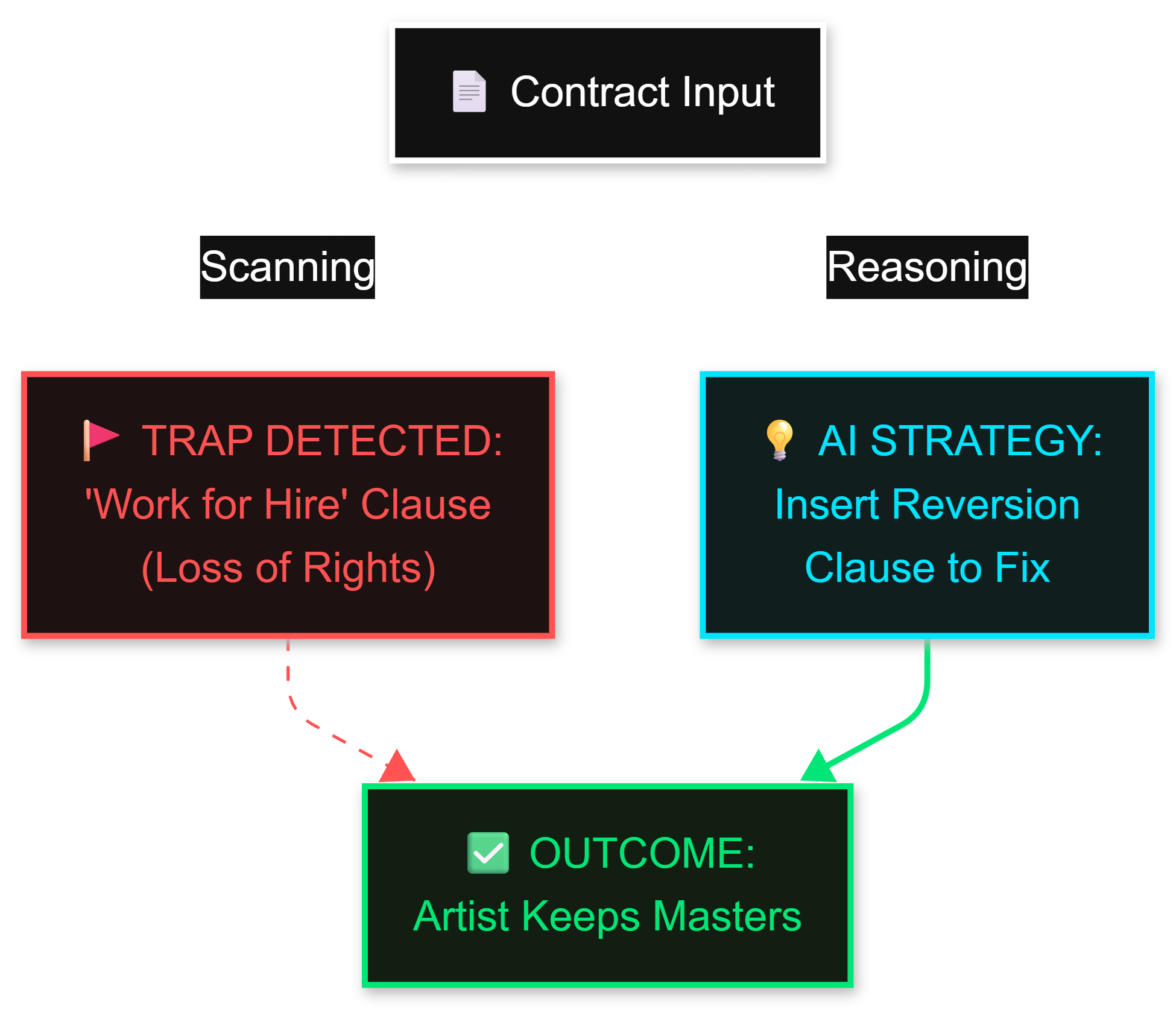
Case Study 2 – The Taylor Swift Lesson (Ownership & Re-recording): Scenario: An independent pop singer is offered a multi-album deal. The contract grants the label ownership of all master recordings in perpetuity (forever). There is no clause allowing the artist to re-record songs after a number of years. What SoundLegal does: The AI highlights the Ownership of Masters section and provides a summary: “The label will own all recordings in this deal forever, with no option for you to regain ownership.” It then references the famous Taylor Swift situation: “Just like Taylor Swift had to re-record her albums because her first label kept the masters, this deal would prevent you from ever owning your recordings unless you negotiate a change or buy them back.” It suggests adding a reversion clause (e.g. rights return to the artist after X years or when certain conditions are met). Outcome: The artist, now aware of this critical issue, can attempt to negotiate a fixed term for master ownership or at least proceed knowing the consequences. SoundLegal has thus educated the creator on perhaps the most important term of their deal – ownership – which might have been overlooked until it was too late.
Case Study 3 – Uncovering Hidden Royalties Pitfalls (Cross-Collateralization): Scenario: A band signs a contract for two albums. The deal includes a clause on “cross-collateralization” of expenses, though not labeled as such. In plain terms, it says any debt (unrecouped balance) from Album 1 can be carried over and recouped from Album 2’s earnings. SoundLegal’s analysis: A generic AI might simply summarize: “This clause discusses recoupment of costs across albums.” But SoundLegal goes further. It identifies this as a Cross-Collateralization clause and explains: “⚠️ Cross-Collateralization: If your first album doesn’t recoup its costs, revenue from your second album will be used to cover the deficit. Risk: You might see little to no royalties from successful Album 2 if Album 1 was unrecouped.* Consider negotiating each album’s finances separately (so one album’s failure can’t swallow another’s success).” Outcome: The band, likely unaware of this concept, now understands the risk. Perhaps they negotiate a cap on expenses or separate accounting for each album. At minimum, they won’t be blindsided two years later when they wonder why they aren’t getting paid for their hit second album – SoundLegal prepared them for this scenario upfront.
Case Study 4 – Empowering a Manager with Rapid Reviews: Scenario: An artist manager handles multiple clients and routinely needs to review various agreements: recording contracts, licensing deals, live performance agreements. Traditionally, the manager might skim these contracts and rely on experience, or forward them to an attorney (incurring delays and costs). Use of SoundLegal: The manager uses SoundLegal as a first-pass filter on every contract. For a distribution deal contract, SoundLegal highlights that the contract grants the distributor rights to artist’s music videos as well, which was unexpected. For a festival performance agreement, the AI flags an unusual clause shifting all liability to the artist for event cancellation (alerting the manager to negotiate that point). In each case, SoundLegal’s instant analysis frees the manager from parsing dense legal text and ensures no major point is missed. Outcome: The manager saves considerable time and can focus on business negotiations armed with the key details. Over a year, this might replace dozens of billable lawyer hours, reserving those for only truly complex issues. The manager also impresses clients by catching issues early – improving their trust in the manager’s diligence.
Case Study 5 – Independent Label Due Diligence: Scenario: A small independent record label uses SoundLegal to standardize and check its own contracts. The label uploads its boilerplate contract to see what an artist using SoundLegal would see. The AI flags a couple of clauses that are very one-sided (perhaps too much so). The label’s execs realize that those terms could scare off savvy artists (or SoundLegal might tell them to be cautious). Wanting to be artist-friendly, the label revises their boilerplate to be more balanced. Outcome: In this case, SoundLegal indirectly encourages fairer contracting. By anticipating how an AI-empowered artist would react, the label preempts issues. This showcases how SoundLegal can contribute to better industry practices overall – when transparency is the norm, contracts can become more equitable.
Case Study 6 - A producer and independent artist agree on terms for a release but need paperwork fast. Using Build mode, they generate a first-draft producer agreement based on structured inputs, then review the output’s plain-English companion notes to confirm mutual understanding of rights, payments, credits, and approvals. The system flags a few negotiation hotspots (ownership of masters, publishing splits, and termination mechanics), enabling an efficient follow-up conversation and a cleaner handoff to legal counsel if needed, reducing delay and ambiguity before distribution.
These examples underscore SoundLegal’s practical value: identifying risks and opportunities in contracts that humans might miss until it’s too late. In beta testing, users reported outcomes like “I almost signed an agreement giving up my future rights, but SoundLegal pointed out exactly what was wrong”, or “SoundLegal explained in 5 minutes what would have taken my lawyer a week – and it caught a mistake in the contract wording that even the other party hadn’t noticed.” Such testimonials (paraphrased from beta feedback) highlight that beyond the flashy AI, it’s the real-world saves that matter. Each use case above illustrates a facet of SoundLegal’s impact: protecting rights, providing negotiation leverage, saving time and money, and generally leveling the playing field for those without easy access to legal teams.
Moreover, these case studies validate SoundLegal’s approach. They show that an AI, when properly trained in a domain, can truly augment human decision-making in that domain. Musicians and creators empowered by SoundLegal become informed negotiators rather than passive signatories. In an industry plagued by stories of “signing blindly and regretting later,” SoundLegal’s early track record is one of flipping the script: knowledge now, instead of lessons learned the hard way later.
Ethical Guardrails and Human Oversight
Deploying an AI in the legal domain, especially one that guides real contractual decisions, demands a strong commitment to ethics and responsible design. SoundLegal AI is built with multiple ethical guardrails and human oversight mechanisms to ensure its advice is reliable, fair, and aligned with users’ best interests, while acknowledging the limitations of AI in legal contexts. Here are the key principles and measures in place:
Not a Lawyer, But an Assistant: SoundLegal is positioned as a tool for information and insight, not as a substitute for licensed legal counsel. Throughout the user experience, the platform includes clear disclaimers that it is not providing legal advice in the formal sense, and that no attorney-client relationship is formed. Users are reminded that while SoundLegal can highlight issues and educate them, final decisions should be made with consideration of human legal advice for critical matters. This transparent messaging is crucial to avoid unauthorized practice of law and to manage user expectations responsibly.
Human-in-the-Loop Oversight: As discussed, human entertainment lawyers have been involved from the ground up in training the model. But the oversight doesn’t stop at training – it continues in deployment. SoundLegal maintains a system where if the AI encounters a novel or highly complex query that it’s uncertain about, it can flag for human review. The SoundLegal team includes legal experts who periodically audit the AI’s outputs (especially in the early stages) to ensure quality and correctness. For enterprise clients (e.g. law firms using SoundLegal internally), the system can be configured such that no report goes out without a human lawyer approving it. While this might not be used in the self-service musician case, it is an available safeguard in professional settings.
Conservative Approach to Uncertainty: The AI is intentionally programmed to be conservative in the face of uncertainty. If it isn’t reasonably sure about an answer or interpretation, it will either refrain from answer or explicitly state uncertainty, rather than guess. For example, if a user asks, “Is this clause enforceable in court?” – something that often depends on jurisdiction and specifics – SoundLegal might respond: “Enforceability can depend on context and jurisdiction. This clause raises potential issues (X, Y), but a human attorney should review to give you a definitive answer.” This guarded approach prevents the AI from overselling its confidence or leading users astray on borderline matters.
No Hallucinated Laws or False Citations: SoundLegal’s outputs are grounded in its knowledge base. The system avoids citing specific case law or statutes unless they are explicitly in its database of verified legal sources. In contrast to some AI systems that might generate a plausible-sounding but fake case reference, SoundLegal either cites actual known authorities or none at all. In many cases, rather than referring to code numbers or case names (which could confuse lay users), it describes principles in plain language. If a law is relevant (e.g. the U.S. Copyright Act’s 35-year reversion right), it will mention it generally and correctly. All such references have been vetted by lawyers during the AI’s development.
Bias and Fairness Considerations: Entertainment contracts often reflect power imbalances (e.g. label vs artist). SoundLegal’s goal is to empower the weaker party (usually the creator) with information. In training, we took care to include perspectives from both sides – but with an eye towards flagging unfair terms. There is a conscious ethical stance: if a clause is heavily one-sided in favor of a company at an artist’s expense, SoundLegal will call it out. This might seem biased against labels or studios, but the intention is to correct an existing imbalance of knowledge. However, SoundLegal does not provide business advice beyond legal implications – for instance, it won’t tell an artist “don’t sign this deal at all” (a business decision), but it will highlight the negatives so the artist can weigh them. We also ensure the AI’s language remains factual and not inflammatory; it presents risks and suggestions but ultimately leaves the decision to the user. The tone is objective (e.g. “Clause X is very unfavorable to you because...”) rather than emotional or biased. This was tuned through iterative feedback to maintain a professional, advisory tone.
Privacy and Data Security: Contracts uploaded to SoundLegal often contain sensitive personal and business information. The platform adheres to strict privacy protocols. Uploaded documents are encrypted in transit and at rest. They are not used to further train the AI model unless explicit permission is given (and even then, any identifying details are removed). SoundLegal’s privacy policy commits that user contracts remain confidential – essentially treating them with similar care as a law firm would with client documents. Access to user data within the company is restricted to authorized personnel on a need-to-know basis (for example, if troubleshooting an analysis issue). These measures are crucial for user trust; creators and companies need to know they can rely on SoundLegal without exposing their secrets. SoundLegal is also exploring compliance with frameworks like ISO 27001 (for info security) to further validate its commitment.
Regulatory Compliance: As AI in law is a nascent area, SoundLegal keeps a close watch on relevant regulations. The platform is built to be compliant with data protection laws (like GDPR) for users in applicable jurisdictions. If a user is in the EU and requests their data be deleted, SoundLegal can permanently erase their uploads and analysis records. Additionally, if jurisdictions were to impose guidelines on AI in legal services, SoundLegal aims to not only comply but set a positive example. By having human lawyers supervise and by avoiding outright legal “advice” wording, the platform navigates the thin line between helpful tool and regulated legal service. The involvement of licensed attorneys in the process also provides a layer of legitimacy and quality control to the AI’s outputs.
Audit Trails and Transparency: Each analysis session in SoundLegal can generate an audit report showing how the AI arrived at its conclusions. Internally, the system can log which parts of a contract triggered which rules or model responses. If ever an output is questioned, this log can be reviewed to understand the AI’s reasoning path. While this isn’t exposed to end-users by default (to avoid overwhelming them), it’s an important feature for internal debugging and for building a transparent development culture. Knowing why SoundLegal flagged something helps improve it and also helps explain to any third-party auditors that the system is behaving rationally, not chaotically.
In designing SoundLegal, we recognized that trust is paramount. Creators might rely on this tool for important decisions, and investors/stakeholders will scrutinize its reliability and legality. Thus, ethics and oversight are not afterthoughts; they are deeply woven into the product. The involvement of human lawyers at multiple stages, the cautious approach to uncertain answers, and the robust privacy measures all serve one purpose: to make SoundLegal safe and trustworthy for public use. We want users to feel confident that while SoundLegal leverages cutting-edge AI, it does so in a way that respects the gravity of legal matters. As we scale, we will continue to invest in these guardrails—because pioneering the AI legal assistant space comes with the responsibility of setting the right precedent for ethical AI deployment.
Market Context: Differentiation from Competitors
The intersection of AI and legal-tech is becoming increasingly crowded, but SoundLegal occupies a unique position. In this section, we outline how SoundLegal stands apart from both traditional solutions and emerging competitors, carving out a leadership role as the go-to AI legal assistant for entertainment:
1. Traditional Methods vs. SoundLegal: The status quo for contract review in the entertainment industry has been either do-it-yourself or hire a lawyer. SoundLegal strikes a middle ground that offers the best of both worlds. Consider the old approach:
DIY Reading: An artist trying to decipher a contract alone often misunderstands key points or misses subtleties, risking their career on a misread clause. It’s like navigating without a map – some manage, many get lost.
Hiring Lawyers: While highly effective, it’s expensive and slow for routine needs. A lawyer might charge $1000 to review a single contract and take several days – a cost-prohibitive and time-consuming approach for many indie creators.
SoundLegal provides a third option: fast, affordable insight that is far more comprehensive than DIY yet far cheaper and quicker than hiring counsel for initial review. Importantly, SoundLegal isn’t about replacing lawyers, but optimizing their involvement. Many entertainment attorneys themselves see value in the tool as a triage system – focusing their time where it’s truly needed (negotiating deal points, giving case-specific advice) while letting the AI handle the heavy lift of first-pass analysis.
2. Generic AI Tools vs. SoundLegal: In recent years, general AI chatbots (like OpenAI’s ChatGPT or Google’s Gemini) have been touted as able to answer any question – including legal ones. However, domain specificity is the key differentiator. SoundLegal is a specialist, whereas those are generalists. Table 1 summarizes the contrast:
| Aspect | Generic AI (ChatGPT, etc.) | SoundLegal AI (Specialist) |
|---|---|---|
| Training Data | Broad internet text (Wikipedia, web forums, etc.) – a mile wide, an inch deep. | Curated entertainment law data: vetted music contracts, relevant case law, industry norms – deeply focused. |
| Legal Accuracy | Prone to hallucination (may invent laws or misapply concepts). No built-in fact-check on legal points. | Attorney-verified outputs; model cross-references known legal rules. Greatly reduces errors and false information. |
| Context Mastery | Often misunderstands industry-specific terms, treating them as general language (e.g. “points” as dots, not royalty percentages). | Knows the jargon and context: e.g. understands “360 deal” means multi-revenue, “sunset clause” in management contracts. No confusion with general contexts. |
| Up-to-date Knowledge | Often limited by a training cutoff (e.g. knowledge as of 2021). May not know recent developments unless manually updated. | Continuously updated with latest entertainment legal developments (new laws, new industry contract standards), acting like a living legal encyclopedia. |
| Output Style | Gives definitions or generic summaries. Might miss implications or not tailor to user’s perspective. | Provides strategic insights: flags risks, suggests negotiation moves. Speaks in plain English tuned to creators, not in legalese. |
| Best For | Creative brainstorming, general Q&A, non-legal tasks (writing lyrics, emails, etc.). | Contract analysis, rights and risk detection, deal review – i.e. the exact niche of music/entertainment contracts. Purpose-built for this job. |
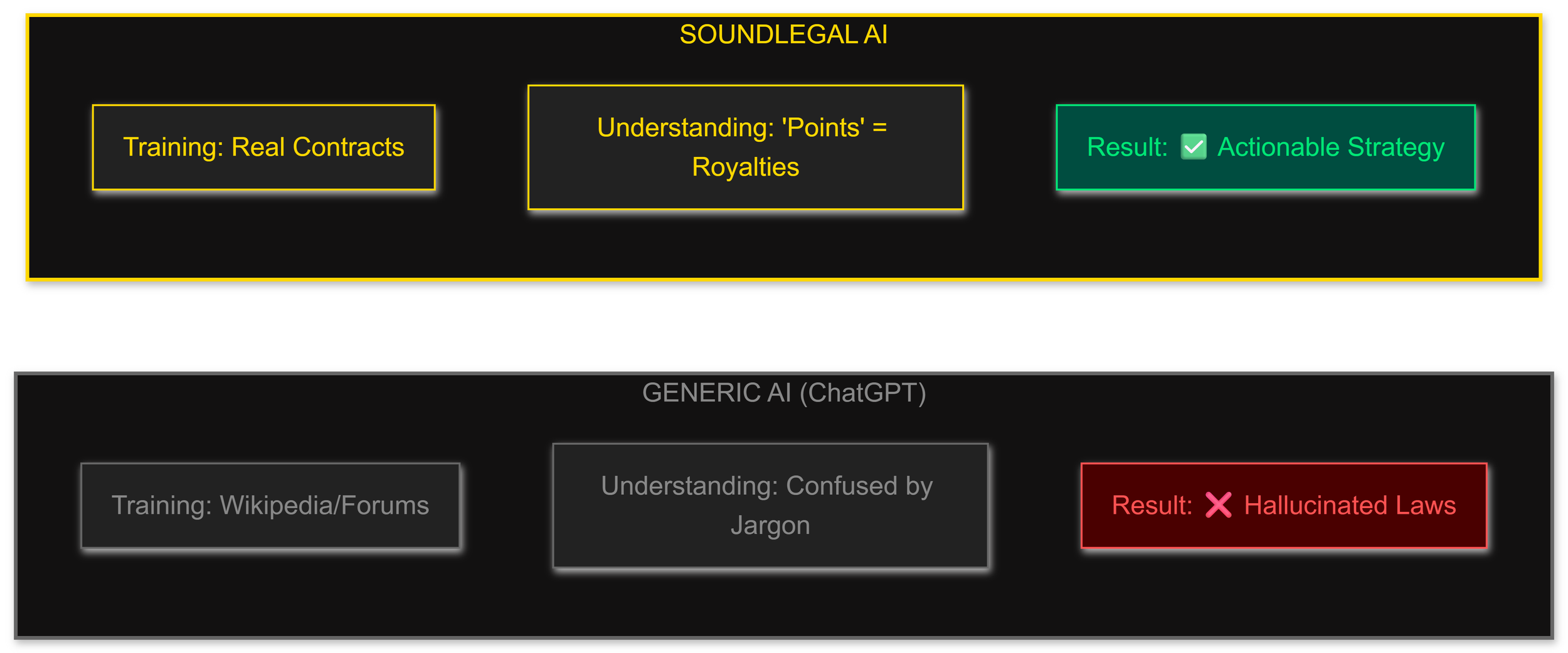
Table 1: Comparing generic AI assistants to SoundLegal’s specialized AI on key dimensions. SoundLegal’s niche training yields more relevant, accurate, and actionable guidance for entertainment contracts.
The difference is stark: you wouldn’t ask a general doctor to perform heart surgery, likewise you shouldn’t use a general chatbot to secure your music rights. SoundLegal positions itself as the surgeon in this analogy – the trained specialist you turn to for mission-critical contract matters, while you might still use generic AI for non-critical creative tasks.
Notably, early tests proved this differentiation. In one experiment, a standard GPT-4 model and SoundLegal AI were both given a complex management contract to analyze. GPT-4 produced a correct literal summary but missed the “sunset clause” entirely (thus failing to warn the artist of ongoing payments to an ex-manager) – because it didn’t recognize the significance. SoundLegal not only flagged the clause, but explained its impact in context (“you will continue paying commission even after the contract ends, for X years, which is unusually long”). This kind of domain-attuned result is SoundLegal’s competitive moat.
3. Other Legal Tech / AI Competitors: There are several players in the broader legal AI and contract analysis markets, but none with SoundLegal’s specific focus and user-centric design for creators:
Enterprise Contract AI (Horizontal): Companies like Luminance, Kira Systems, or Evisort offer AI contract review, but their products target corporate legal departments, big law firms, or enterprise deal management. They are built for lawyers reviewing high volumes of contracts (e.g., due diligence in mergers, compliance checks) and often require training to use. These tools are typically generalized or finance/legal oriented and not specialized in entertainment. Moreover, their UIs and outputs assume a legally trained user. By contrast, SoundLegal is purpose-built for non-lawyers in entertainment. It focuses on one contract at a time, providing explanation rather than just data extraction, and it emphasizes education (so creators learn from it). Price-wise, enterprise solutions are also priced for companies, whereas SoundLegal’s model is affordable for individuals.
Legal AI Assistants (Lawyer-focused): There are AI systems like Harvey (an AI assistant for big law firms) or Spellbook (which integrates with lawyers’ contract drafting tools) that garnered attention in 2023-2024. These are impressive but again target the lawyer as the user, not the artist or creator. Spellbook might help a lawyer draft a contract faster, but that doesn’t directly help an artist who doesn’t have Spellbook or know how to prompt it. SoundLegal flips the script by targeting the artist/creator as the user. Additionally, those systems are general in law domain or focus on things like quick clause suggestions in corporate contracts; they lack entertainment-specific training and content. A big-law AI might know the rule against perpetuities, but not necessarily the intricacies of a synchronization license. SoundLegal fills that gap.
Music Industry AI startups: We’re aware of emerging tools like Creative Intell, which is developing an AI-driven deal platform for music, and MusicLawyer.ai, an app launched in 2024 that uses ChatGPT to flag issues in music contracts. The very existence of these validates the market need – however, SoundLegal maintains a first-mover advantage in terms of depth and approach. For instance, MusicLawyer.ai (launched by a music producer) is a free tool using off-the-shelf AI; it can do OCR and highlight missing info, but even its founder cautions it’s not a replacement for legal advice and is more of a basic “clarification” tool. It essentially offers a minimal checklist, powered by general models, and is in early stages of drafting simple contracts. SoundLegal, on the other hand, offers a far richer analysis (clause explanations, risk alerts, negotiation advice) and is backed by a proprietary model with attorney training – a much higher bar for quality and reliability. While MusicLawyer and others signal interest in the space, SoundLegal’s domain-tuned AI and comprehensive feature set position it as the premium, professional-grade solution among these. It’s the difference between a basic grammar checker and a full writing assistant – both have a place, but the latter delivers a lot more value.
Other Domain AI Tools: It’s worth noting that in adjacent domains (like film/TV contracts or book publishing contracts), no comparable AI assistant yet exists. SoundLegal is poised to extend its lead here by eventually expanding into those areas (see Roadmap). The know-how gained in music industry deals provides a blueprint. Early foothold in music gives SoundLegal the data and credibility to branch out to other entertainment verticals faster than any new entrant starting from scratch in those.
To summarize, SoundLegal’s differentiation comes down to specialization, usability, and credibility. It’s specialized where others are generic; it’s built for creators where others cater to lawyers or enterprise; and it’s backed by real legal expertise where others rely on vanilla AI. We often describe our advantage as a “defensible moat”: the proprietary contract data and the expert-in-the-loop training are assets and processes that aren’t easily replicated by would-be competitors or Big Tech companies, especially not within a niche market that requires trust and domain insight. By the time a large language model from a big provider is manually fine-tuned for music law (if ever), SoundLegal intends to have become the household name (or rather, studio name) for AI contract review in the creative world.
Market timing also favors SoundLegal. Creators’ awareness of the need for such tools is at an all-time high (thanks to widely publicized contract disputes), and AI technology is mature enough now to deliver real value. This is a classic scenario of right solution at the right time. Competitors exist, but none check all the boxes that SoundLegal does: music-trained, lawyer-approved, instant, user-friendly, and already operational. As a result, SoundLegal is not just entering the market – it’s defining a new category: the AI legal assistant for the entertainment industry.
Roadmap & Impact Potential
Having established a strong foundation in the music sector, SoundLegal.AI is poised for significant growth and broader impact. Our roadmap balances near-term enhancements with a long-term vision of transforming how legal agreements are understood across entertainment (and eventually other domains). Here’s a look at where SoundLegal is headed and the potential it holds:
Music Industry Core
- Recording Contracts
- Publishing Deals
- Manager Agreements
Film & TV Expansion
- Talent Agreements
- Distribution Deals
- Production Options
The Creator Economy
- Influencer Brand Deals
- Gaming Contracts
- Book Publishing
Near-Term Developments (Next 12–18 months):
Expanded Contract Coverage: In the immediate future, we plan to extend SoundLegal’s expertise beyond music recording and publishing contracts to other contract types in entertainment. This includes film and television contracts (options agreements, talent agreements, distribution deals), video game and interactive media contracts (for composers and developers), and more comprehensive coverage of live event contracts (festival performance agreements, tour contracts). The underlying AI model will be further fine-tuned with documents and nuances from these domains, many of which share similarities with music contracts (e.g. rights granted, royalties or residuals, term lengths). This expansion will broaden our user base to filmmakers, actors, producers, and other entertainment professionals.
Refined AI Model & Features: Technical improvements are continually in the pipeline. We are working on the next iteration of our model with even finer industry tuning and better handling of long documents (leveraging improved context window capabilities of new LLM architectures). Multi-party contract analysis is a feature under development: the ability to adjust analysis perspective depending on whether you’re an artist, a label, a manager, etc. For instance, a manager uploading an artist–manager agreement might get insights from the manager’s angle as well as the artist’s, to facilitate fair negotiation. We are also building a clause negotiation simulator, where the user can tweak a clause (e.g. change 5 years to 3 years term) and the AI will re-evaluate the contract and forecast the implications or likely pushback from the other party. This helps users “practice” negotiation changes in a sandbox.
Drafting and Template Suggestions: By popular demand, a forthcoming feature will enable SoundLegal not only to analyze contracts but to assist in drafting or modifying them. For example, if SoundLegal flags a missing reversion clause, the user could ask, “Can you provide a sample reversion clause to add?” The AI, guided by legal templates and attorney oversight, could then suggest a clause (with appropriate caveats that a human lawyer review it). This doesn’t turn SoundLegal into a contract generator per se, but it moves us into the realm of assisting deal-making, not just deal review. It aligns with our mission of being a “legal assistant” that can help at multiple stages of the contract lifecycle.
Integration & Partnerships: On the business side, we plan to integrate SoundLegal into platforms where creators already operate. This includes discussions with digital distribution platforms, music aggregators, and even PROs (performing rights organizations). The vision is that a user on, say, a music distribution site could click “Analyze with SoundLegal” right when they’re presented a distribution contract. We’re also exploring bundling SoundLegal for music unions or associations as a member benefit, and partnerships with law firms to use SoundLegal as an initial screening tool for their clients (improving lawyer efficiency while giving SoundLegal wider reach). These partnerships will help SoundLegal become ubiquitous in the entertainment industry workflow.
Long-Term Vision (2–5 years):
The Go-To Legal Assistant for All Creators: We envision SoundLegal evolving into a comprehensive legal companion for creators across domains – “SoundLegal” becomes a bit of a misnomer as we extend beyond music. In 2–3 years, we aim for our platform to cover all entertainment verticals: music, film, TV, digital content creation (e.g. YouTubers’ brand deals), book publishing, and more. The core technology (AI understanding contracts + domain tuning) scales well; it’s largely a matter of obtaining domain-specific data and expertise for each new vertical, a process we’ve proven in music and can replicate. By being first in music, we have a head start to sequentially tackle these other creator markets. The broader impact is empowering millions of creators – from indie musicians and filmmakers to authors and influencers – with accessible legal insight. This expansion multiplies our addressable market and positions SoundLegal as a category leader in creative legal tech.
AI as Industry Standard in Deals: We foresee a future where it becomes standard practice that every contract comes with an AI analysis attached. SoundLegal can spearhead this change in entertainment. For instance, record labels might attach a “SoundLegal summary” to their contracts to show transparency (or artists will demand it). This is similar to how some consumer contracts now come with “plain language summaries.” SoundLegal’s neutral, AI-generated perspective could even become a part of contract negotiations – where both sides use the AI to quickly find middle ground or clarify disagreements. The technology might also feed into contract creation: imagine labels or studios using a SoundLegal contract drafting assistant to create fairer contracts from the outset by checking biases or overreaches in language as they write. In essence, SoundLegal could help raise the bar industry-wide, reducing the incidence of “nasty surprises” in contracts and thereby reducing costly disputes later.
Platform Intelligence and Data Insights: As usage grows, SoundLegal will accumulate an unprecedented data set of how contracts vary and what issues are most common. Aggregate analysis (done in a privacy-preserving way) could yield valuable industry insights: e.g., “70% of indie label contracts in 2026 have a 15% royalty rate, up from 10% five years ago,” or “Only 20% of festival performance contracts include an inclement weather cancellation clause – a potential gap.” These insights could be published (anonymously and in aggregate) as industry reports or “State of the Deal” whitepapers, establishing SoundLegal as an authority on entertainment deal trends. This thought leadership not only provides marketing value but also contributes positively to industry transparency.
Regulatory and Policy Influence: By being a pioneer in AI for creator rights, SoundLegal may also have a seat at the table in policy discussions. For example, if governments or guilds discuss standardizing certain contract terms or regulating fair contracts for artists, SoundLegal’s data and expertise could inform those dialogues. Our long-term impact could thus extend beyond technology into shaping a fairer legal landscape for creators at large.
Scaling the Infrastructure: On a technical note, our roadmap includes migrating to more advanced AI frameworks as they become available (to keep improving speed and accuracy), and ensuring scalability to handle potentially tens of thousands of users and documents concurrently. Cloud optimization and possibly a dedicated API product for high-volume customers (like law firms that want to run batches of contracts through SoundLegal) are on the horizon. We are also keeping an eye on advancements in explainable AI, as these could allow SoundLegal to provide even more transparency in its reasoning (which would further increase user trust, especially for enterprise adoption).
Monetization & Growth: From an investment perspective, the roadmap is tied to a scalable SaaS model. After the current closed beta, we plan a tiered subscription offering – from individual creators (affordable monthly plans) to professional/enterprise tiers for firms or labels (with collaboration features and volume use). Growth will come from direct marketing to creators, partnerships as noted, and channel sales through industry service providers. As of 2025, the legal AI software market is projected to grow robustly (on track to reach an estimated $10+ billion globally by 2030), and we expect SoundLegal to capture a significant portion of the entertainment slice of that, with potential to expand horizontally thereafter. The funding we seek is aimed squarely at executing this roadmap: data acquisition for new domains, product development for new features, and marketing outreach to cement our leadership.
Impact Potential: In sum, the impact of SoundLegal at scale is transformational. If we succeed, no artist or creator will ever have to say “I didn’t understand what I signed” again. The knowledge asymmetry that has plagued entertainment contracts for over a century could finally balance out: young creators will enter agreements with clarity previously reserved for those who could afford top lawyers. This can lead to fewer exploitation stories, more equitable earnings distribution, and perhaps even more creative freedom (as creators won’t fear the fine print stifling their art). The industry, in turn, benefits from smoother relationships and fewer litigations born of misunderstanding or hidden terms.
For investors and stakeholders, the roadmap illustrates both a sustainable growth path and a significant value creation opportunity. SoundLegal isn’t just a one-off app; it’s a platform with expanding domains, deepening technology moat, and the chance to become the default infrastructure for contract understanding in the creator economy. Each new vertical or feature opens a new revenue stream and fortifies the product’s utility, driving a flywheel of more data, better AI, and thus more value.
As we pursue this roadmap, we remain aware that trust and quality are our north stars. We will not sacrifice depth for speed of expansion. Each step into a new domain will involve the same careful curation and expert input that made our music product successful. This deliberate, quality-first approach is how we envision capturing the market and genuinely improving it. The potential is that in a few years’ time, SoundLegal could be as essential to a creator’s toolkit as their distribution platform or their social media – an ever-present guardian and guide in the business of creativity.
Conclusion: Call to Collaboration and Investment
SoundLegal AI stands at the forefront of a new era in legal-tech, one where AI is finally tailored to the nuances of a specific domain and user base. In this whitepaper, we have shown that SoundLegal is not just another generic AI wrapper, but a carefully engineered platform combining proprietary data, specialized models, and human expertise. It addresses a painfully real problem in the music and entertainment industry – the opacity of contracts – with a solution that is as elegant as it is powerful: instant, intelligible analysis that any creator can use.
For creators and entertainment professionals, SoundLegal is more than a tool; it’s a safeguard for your passion and livelihood. It translates the fine print into a clear narrative of your deal, flags the traps that could snare your rights, and essentially puts a virtual lawyer in your corner whenever you need one. We invite artists, managers, indie labels, and lawyers alike to join us in using SoundLegal and providing feedback. Every contract analyzed is another step towards an industry where knowledge is democratized.
For investors and collaborators, SoundLegal represents a compelling opportunity to back a truly differentiated venture in the AI space. We’ve proven on a small scale that the technology works and that users are eager for it (with beta testers validating both the need and the solution). The foundation is laid: the AI architecture, the datasets, the initial user traction. What lies ahead is a classic scale-up story – expanding features, expanding markets, and cementing market leadership. We are seeking partners who share our vision of AI that augments human expertise rather than replaces it, and who recognize the untapped potential of niche-focused AI platforms. With your support, SoundLegal can accelerate its roadmap, from onboarding thousands of musicians to entering film, sports, and beyond.
The broader vision is ambitious: a world where no creator signs a bad deal unwittingly, where AI-driven transparency becomes the norm, and where SoundLegal is the trusted intermediary translating legalese to common sense across industries. By investing in SoundLegal, you are investing in the infrastructure of the creator economy – a growing sector that thrives when creators are empowered and protected.
In closing, we call upon all forward-thinking stakeholders – from venture investors and music industry leaders to law firms and tech partners – to collaborate with us. Let’s combine our resources, expertise, and networks to scale SoundLegal’s impact. Whether it’s through funding, partnerships, or simply spreading the word to those who need it, your involvement can help catalyze this much-needed change in the entertainment world.
SoundLegal has already begun rewriting the narrative of artist contracts from one of regret to one of informed choice. Together, we can accelerate this change. Join us in bringing legal clarity to every creator’s journey, and in doing so, capture a unique business opportunity that aligns profit with purpose. The stage is set, the technology is proven – now it’s time to amplify SoundLegal’s reach and write the next verse of this success story in collaboration with you.
Let’s simplify contracts today, so creators can create freely tomorrow.