
Value Proof: Case Studies and Use Cases
The true measure of SoundLegal’s impact is how it performs in real-world scenarios. Below, we highlight several illustrative use cases and early case studies demonstrating how the platform adds value across the music and entertainment industry:
Case Study 1 – Saving an Artist’s Masters (Work-for-Hire Trap)
Scenario: A rising hip-hop duo receives their first recording contract from a label. Buried in the contract is a clause declaring all recordings as “works made for hire.” The artists, excited and inexperienced, might have glossed over this legal phrase. What happened: Using SoundLegal AI, they upload the contract. The system immediately flags the “Work for Hire” language with a red alert: “⚠️ This clause classifies your recordings as ‘work for hire,’ meaning you will not own your masters – the label will. You lose the right to reclaim your music later.”
It explains the long-term consequence: under U.S. law, works for hire are ineligible for the usual 35-year copyright reversion that artists can use to get their rights back. Outcome: Armed with this insight, the duo renegotiates the clause (or at least understands the stakes and can make an informed decision). They avoid signing away their master rights unknowingly, potentially preserving millions in future value. (This scenario is informed by real events – e.g., Salt-N-Pepa’s recent court battle where a “work for hire” clause from decades ago prevented them from reclaiming their masters. SoundLegal aims to ensure today’s artists don’t become tomorrow’s cautionary tale.)
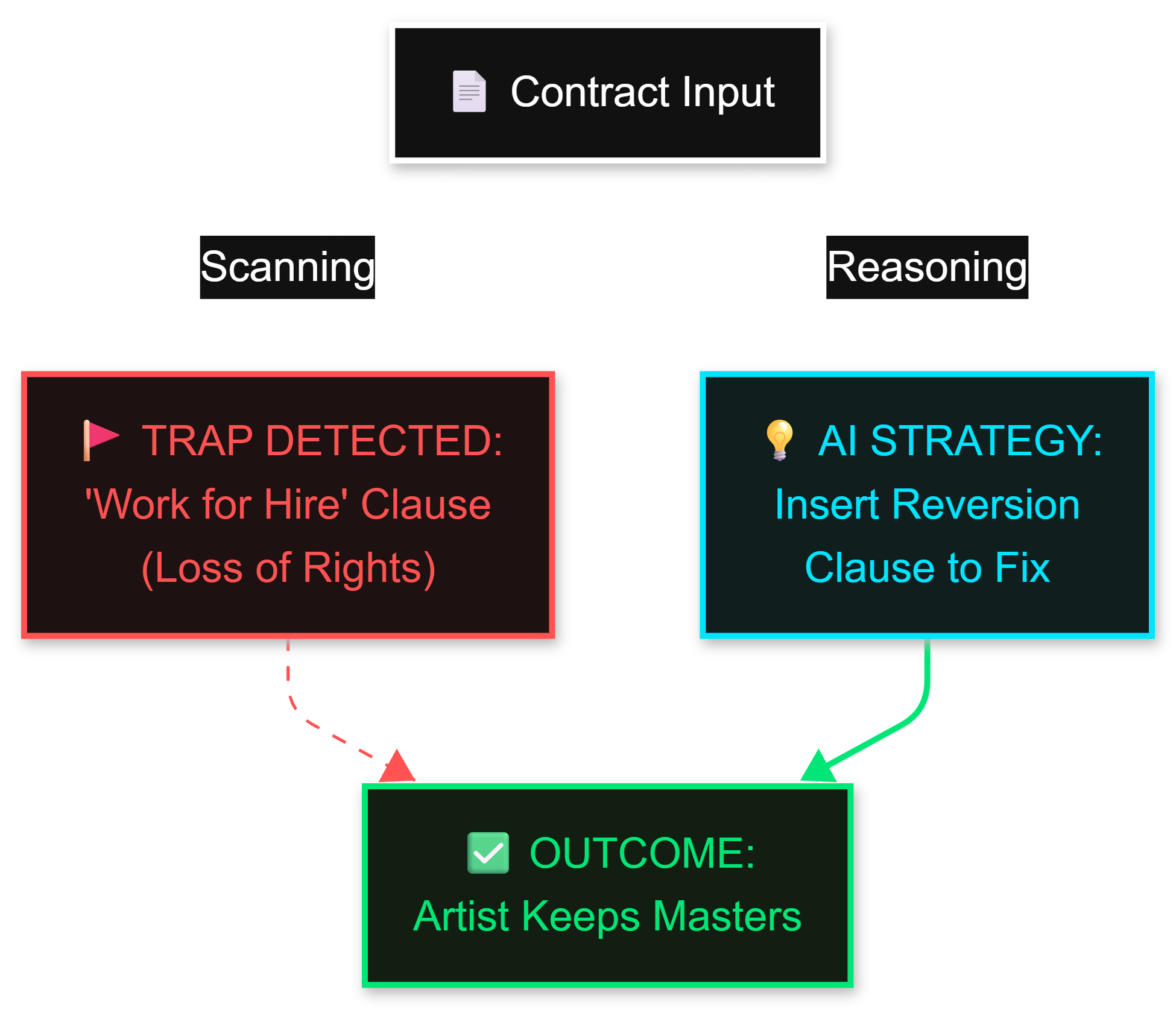
Logic Visualization: Trap Detection & Resolution Strategy.
Case Study 2 – The Taylor Swift Lesson (Ownership & Re-recording)
Scenario: An independent pop singer is offered a multi-album deal. The contract grants the label ownership of all master recordings in perpetuity (forever). There is no clause allowing the artist to re-record songs after a number of years. What SoundLegal does: The AI highlights the Ownership of Masters section and provides a summary: “The label will own all recordings in this deal forever, with no option for you to regain ownership.” It then references the famous Taylor Swift situation: “Just like Taylor Swift had to re-record her albums because her first label kept the masters, this deal would prevent you from ever owning your recordings unless you negotiate a change or buy them back.” It suggests adding a reversion clause (e.g. rights return to the artist after X years or when certain conditions are met). Outcome: The artist, now aware of this critical issue, can attempt to negotiate a fixed term for master ownership or at least proceed knowing the consequences. SoundLegal has thus educated the creator on perhaps the most important term of their deal – ownership – which might have been overlooked until it was too late.
Case Study 3 – Uncovering Hidden Royalties Pitfalls (Cross-Collateralization)
Scenario: A band signs a contract for two albums. The deal includes a clause on “cross-collateralization” of expenses, though not labeled as such. In plain terms, it says any debt (unrecouped balance) from Album 1 can be carried over and recouped from Album 2’s earnings. SoundLegal’s analysis: A generic AI might simply summarize: “This clause discusses recoupment of costs across albums.” But SoundLegal goes further. It identifies this as a Cross-Collateralization clause and explains: “⚠️ Cross-Collateralization: If your first album doesn’t recoup its costs, revenue from your second album will be used to cover the deficit. Risk: You might see little to no royalties from successful Album 2 if Album 1 was unrecouped.* Consider negotiating each album’s finances separately (so one album’s failure can’t swallow another’s success).” Outcome: The band, likely unaware of this concept, now understands the risk. Perhaps they negotiate a cap on expenses or separate accounting for each album. At minimum, they won’t be blindsided two years later when they wonder why they aren’t getting paid for their hit second album – SoundLegal prepared them for this scenario upfront.
Case Study 4 – Empowering a Manager with Rapid Reviews
Scenario: An artist manager handles multiple clients and routinely needs to review various agreements: recording contracts, licensing deals, live performance agreements. Traditionally, the manager might skim these contracts and rely on experience, or forward them to an attorney (incurring delays and costs). Use of SoundLegal: The manager uses SoundLegal as a first-pass filter on every contract. For a distribution deal contract, SoundLegal highlights that the contract grants the distributor rights to artist’s music videos as well, which was unexpected. For a festival performance agreement, the AI flags an unusual clause shifting all liability to the artist for event cancellation (alerting the manager to negotiate that point). In each case, SoundLegal’s instant analysis frees the manager from parsing dense legal text and ensures no major point is missed. Outcome: The manager saves considerable time and can focus on business negotiations armed with the key details. Over a year, this might replace dozens of billable lawyer hours, reserving those for only truly complex issues. The manager also impresses clients by catching issues early – improving their trust in the manager’s diligence.
Case Study 5 – Independent Label Due Diligence
Scenario: A small independent record label uses SoundLegal to standardize and check its own contracts. The label uploads its boilerplate contract to see what an artist using SoundLegal would see. The AI flags a couple of clauses that are very one-sided (perhaps too much so). The label’s execs realize that those terms could scare off savvy artists (or SoundLegal might tell them to be cautious). Wanting to be artist-friendly, the label revises their boilerplate to be more balanced. Outcome: In this case, SoundLegal indirectly encourages fairer contracting. By anticipating how an AI-empowered artist would react, the label preempts issues. This showcases how SoundLegal can contribute to better industry practices overall – when transparency is the norm, contracts can become more equitable.
Case Study 6 – Rapid Agreement Drafting
A producer and independent artist agree on terms for a release but need paperwork fast. Using Build mode, they generate a first-draft producer agreement based on structured inputs, then review the output’s plain-English companion notes to confirm mutual understanding of rights, payments, credits, and approvals. The system flags a few negotiation hotspots (ownership of masters, publishing splits, and termination mechanics), enabling an efficient follow-up conversation and a cleaner handoff to legal counsel if needed, reducing delay and ambiguity before distribution.
These examples underscore SoundLegal’s practical value: identifying risks and opportunities in contracts that humans might miss until it’s too late. In beta testing, users reported outcomes like “I almost signed an agreement giving up my future rights, but SoundLegal pointed out exactly what was wrong”, or “SoundLegal explained in 5 minutes what would have taken my lawyer a week – and it caught a mistake in the contract wording that even the other party hadn’t noticed.” Such testimonials (paraphrased from beta feedback) highlight that beyond the flashy AI, it’s the real-world saves that matter. Each use case above illustrates a facet of SoundLegal’s impact: protecting rights, providing negotiation leverage, saving time and money, and generally leveling the playing field for those without easy access to legal teams.
Moreover, these case studies validate SoundLegal’s approach. They show that an AI, when properly trained in a domain, can truly augment human decision-making in that domain. Musicians and creators empowered by SoundLegal become informed negotiators rather than passive signatories. In an industry plagued by stories of “signing blindly and regretting later,” SoundLegal’s early track record is one of flipping the script: knowledge now, instead of lessons learned the hard way later.