
Market Context: Differentiation from Competitors
The intersection of AI and legal-tech is becoming increasingly crowded, but SoundLegal occupies a unique position. In this section, we outline how SoundLegal stands apart from both traditional solutions and emerging competitors, carving out a leadership role as the go-to AI legal assistant for entertainment:
1. Traditional Methods vs. SoundLegal
The status quo for contract review in the entertainment industry has been either do-it-yourself or hire a lawyer. SoundLegal strikes a middle ground that offers the best of both worlds. Consider the old approach:
- DIY Reading: An artist trying to decipher a contract alone often misunderstands key points or misses subtleties, risking their career on a misread clause. It’s like navigating without a map – some manage, many get lost.
- Hiring Lawyers: While highly effective, it’s expensive and slow for routine needs. A lawyer might charge $1000 to review a single contract and take several days – a cost-prohibitive and time-consuming approach for many indie creators.
SoundLegal provides a third option: fast, affordable insight that is far more comprehensive than DIY yet far cheaper and quicker than hiring counsel for initial review. Importantly, SoundLegal isn’t about replacing lawyers, but optimizing their involvement. Many entertainment attorneys themselves see value in the tool as a triage system – focusing their time where it’s truly needed (negotiating deal points, giving case-specific advice) while letting the AI handle the heavy lift of first-pass analysis.
2. Generic AI Tools vs. SoundLegal
In recent years, general AI chatbots (like OpenAI’s ChatGPT or Google’s Gemini) have been touted as able to answer any question – including legal ones. However, domain specificity is the key differentiator. SoundLegal is a specialist, whereas those are generalists. Table 1 summarizes the contrast:
| Aspect | Generic AI (ChatGPT, etc.) | SoundLegal AI (Specialist) |
|---|---|---|
| Training Data | Broad internet text (Wikipedia, web forums, etc.) – a mile wide, an inch deep. | Curated entertainment law data: vetted music contracts, relevant case law, industry norms – deeply focused. |
| Legal Accuracy | Prone to hallucination (may invent laws or misapply concepts). No built-in fact-check on legal points. | Attorney-verified outputs; model cross-references known legal rules. Greatly reduces errors and false information. |
| Context Mastery | Often misunderstands industry-specific terms, treating them as general language (e.g. “points” as dots, not royalty percentages). | Knows the jargon and context: e.g. understands “360 deal” means multi-revenue, “sunset clause” in management contracts. No confusion with general contexts. |
| Up-to-date Knowledge | Often limited by a training cutoff (e.g. knowledge as of 2021). May not know recent developments unless manually updated. | Continuously updated with latest entertainment legal developments (new laws, new industry contract standards), acting like a living legal encyclopedia. |
| Output Style | Gives definitions or generic summaries. Might miss implications or not tailor to user’s perspective. | Provides strategic insights: flags risks, suggests negotiation moves. Speaks in plain English tuned to creators, not in legalese. |
| Best For | Creative brainstorming, general Q&A, non-legal tasks (writing lyrics, emails, etc.). | Contract analysis, rights and risk detection, deal review – i.e. the exact niche of music/entertainment contracts. Purpose-built for this job. |
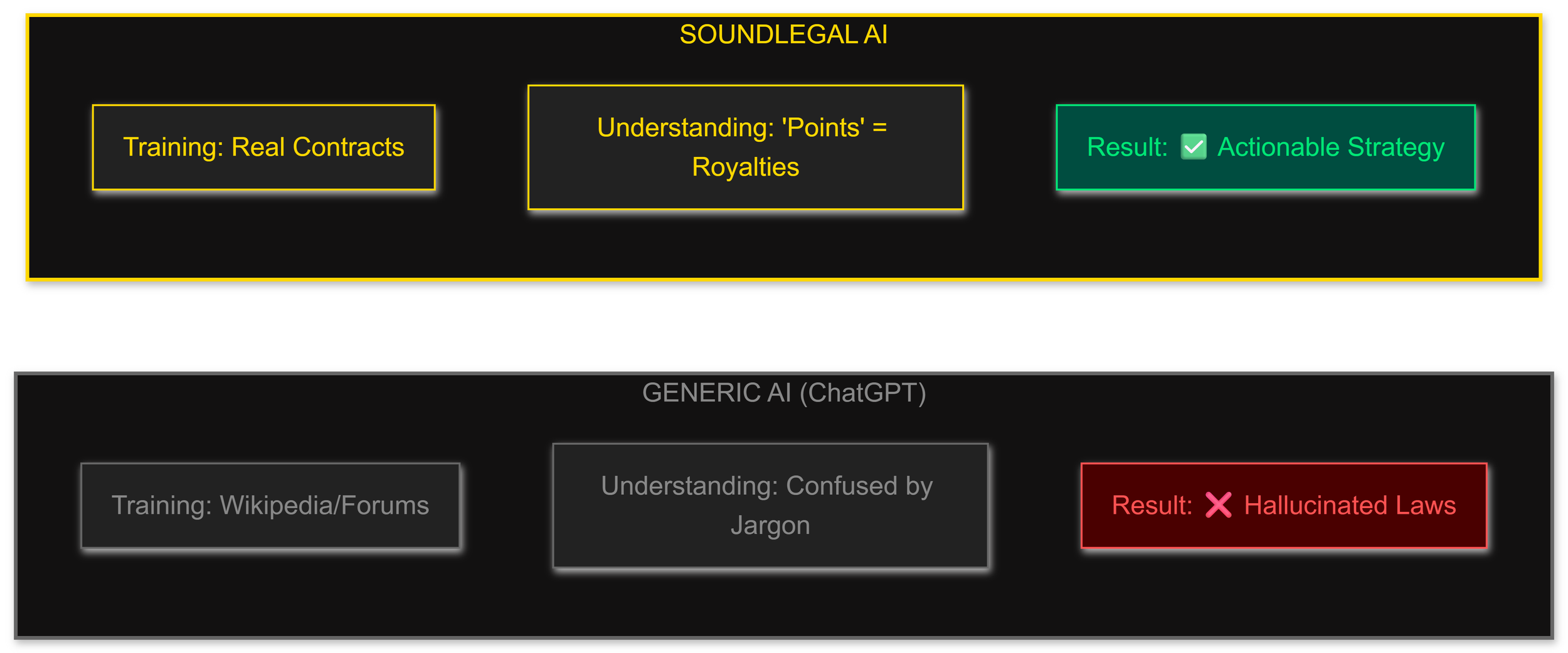
The difference is stark: you wouldn’t ask a general doctor to perform heart surgery, likewise you shouldn’t use a general chatbot to secure your music rights. SoundLegal positions itself as the surgeon in this analogy – the trained specialist you turn to for mission-critical contract matters, while you might still use generic AI for non-critical creative tasks.
Notably, early tests proved this differentiation. In one experiment, a standard GPT-4 model and SoundLegal AI were both given a complex management contract to analyze. GPT-4 produced a correct literal summary but missed the “sunset clause” entirely (thus failing to warn the artist of ongoing payments to an ex-manager) – because it didn’t recognize the significance. SoundLegal not only flagged the clause, but explained its impact in context (“you will continue paying commission even after the contract ends, for X years, which is unusually long”). This kind of domain-attuned result is SoundLegal’s competitive moat.
3. Other Legal Tech / AI Competitors
There are several players in the broader legal AI and contract analysis markets, but none with SoundLegal’s specific focus and user-centric design for creators:
- Enterprise Contract AI (Horizontal): Companies like Luminance, Kira Systems, or Evisort offer AI contract review, but their products target corporate legal departments, big law firms, or enterprise deal management. They are built for lawyers reviewing high volumes of contracts (e.g., due diligence in mergers, compliance checks) and often require training to use. These tools are typically generalized or finance/legal oriented and not specialized in entertainment. Moreover, their UIs and outputs assume a legally trained user. By contrast, SoundLegal is purpose-built for non-lawyers in entertainment. It focuses on one contract at a time, providing explanation rather than just data extraction, and it emphasizes education (so creators learn from it). Price-wise, enterprise solutions are also priced for companies, whereas SoundLegal’s model is affordable for individuals.
- Legal AI Assistants (Lawyer-focused): There are AI systems like Harvey (an AI assistant for big law firms) or Spellbook (which integrates with lawyers’ contract drafting tools) that garnered attention in 2023-2024. These are impressive but again target the lawyer as the user, not the artist or creator. Spellbook might help a lawyer draft a contract faster, but that doesn’t directly help an artist who doesn’t have Spellbook or know how to prompt it. SoundLegal flips the script by targeting the artist/creator as the user. Additionally, those systems are general in law domain or focus on things like quick clause suggestions in corporate contracts; they lack entertainment-specific training and content. A big-law AI might know the rule against perpetuities, but not necessarily the intricacies of a synchronization license. SoundLegal fills that gap.
- Music Industry AI startups: We’re aware of emerging tools like Creative Intell, which is developing an AI-driven deal platform for music, and MusicLawyer.ai, an app launched in 2024 that uses ChatGPT to flag issues in music contracts. The very existence of these validates the market need – however, SoundLegal maintains a first-mover advantage in terms of depth and approach. For instance, MusicLawyer.ai (launched by a music producer) is a free tool using off-the-shelf AI; it can do OCR and highlight missing info, but even its founder cautions it’s not a replacement for legal advice and is more of a basic “clarification” tool. It essentially offers a minimal checklist, powered by general models, and is in early stages of drafting simple contracts. SoundLegal, on the other hand, offers a far richer analysis (clause explanations, risk alerts, negotiation advice) and is backed by a proprietary model with attorney training – a much higher bar for quality and reliability. While MusicLawyer and others signal interest in the space, SoundLegal’s domain-tuned AI and comprehensive feature set position it as the premium, professional-grade solution among these. It’s the difference between a basic grammar checker and a full writing assistant – both have a place, but the latter delivers a lot more value.
- Other Domain AI Tools: It’s worth noting that in adjacent domains (like film/TV contracts or book publishing contracts), no comparable AI assistant yet exists. SoundLegal is poised to extend its lead here by eventually expanding into those areas (see Roadmap). The know-how gained in music industry deals provides a blueprint. Early foothold in music gives SoundLegal the data and credibility to branch out to other entertainment verticals faster than any new entrant starting from scratch in those.
To summarize, SoundLegal’s differentiation comes down to specialization, usability, and credibility. It’s specialized where others are generic; it’s built for creators where others cater to lawyers or enterprise; and it’s backed by real legal expertise where others rely on vanilla AI. We often describe our advantage as a “defensible moat”: the proprietary contract data and the expert-in-the-loop training are assets and processes that aren’t easily replicated by would-be competitors or Big Tech companies, especially not within a niche market that requires trust and domain insight. By the time a large language model from a big provider is manually fine-tuned for music law (if ever), SoundLegal intends to have become the household name (or rather, studio name) for AI contract review in the creative world.
Market timing also favors SoundLegal. Creators’ awareness of the need for such tools is at an all-time high (thanks to widely publicized contract disputes), and AI technology is mature enough now to deliver real value. This is a classic scenario of right solution at the right time. Competitors exist, but none check all the boxes that SoundLegal does: music-trained, lawyer-approved, instant, user-friendly, and already operational. As a result, SoundLegal is not just entering the market – it’s defining a new category: the AI legal assistant for the entertainment industry.
Roadmap & Impact Potential
Having established a strong foundation in the music sector, SoundLegal.AI is poised for significant growth and broader impact. Our roadmap balances near-term enhancements with a long-term vision of transforming how legal agreements are understood across entertainment (and eventually other domains). Here’s a look at where SoundLegal is headed and the potential it holds:
Music Industry Core
- Recording Contracts
- Publishing Deals
- Manager Agreements
Film & TV Expansion
- Talent Agreements
- Distribution Deals
- Production Options
The Creator Economy
- Influencer Brand Deals
- Gaming Contracts
- Book Publishing
Near-Term Developments (Next 12–18 months)
- Expanded Contract Coverage: In the immediate future, we plan to extend SoundLegal’s expertise beyond music recording and publishing contracts to other contract types in entertainment. This includes film and television contracts (options agreements, talent agreements, distribution deals), video game and interactive media contracts (for composers and developers), and more comprehensive coverage of live event contracts (festival performance agreements, tour contracts). The underlying AI model will be further fine-tuned with documents and nuances from these domains, many of which share similarities with music contracts (e.g. rights granted, royalties or residuals, term lengths). This expansion will broaden our user base to filmmakers, actors, producers, and other entertainment professionals.
- Refined AI Model & Features: Technical improvements are continually in the pipeline. We are working on the next iteration of our model with even finer industry tuning and better handling of long documents (leveraging improved context window capabilities of new LLM architectures). Multi-party contract analysis is a feature under development: the ability to adjust analysis perspective depending on whether you’re an artist, a label, a manager, etc. For instance, a manager uploading an artist–manager agreement might get insights from the manager’s angle as well as the artist’s, to facilitate fair negotiation. We are also building a clause negotiation simulator, where the user can tweak a clause (e.g. change 5 years to 3 years term) and the AI will re-evaluate the contract and forecast the implications or likely pushback from the other party. This helps users “practice” negotiation changes in a sandbox.
- Drafting and Template Suggestions: By popular demand, a forthcoming feature will enable SoundLegal not only to analyze contracts but to assist in drafting or modifying them. For example, if SoundLegal flags a missing reversion clause, the user could ask, “Can you provide a sample reversion clause to add?” The AI, guided by legal templates and attorney oversight, could then suggest a clause (with appropriate caveats that a human lawyer review it). This doesn’t turn SoundLegal into a contract generator per se, but it moves us into the realm of assisting deal-making, not just deal review. It aligns with our mission of being a “legal assistant” that can help at multiple stages of the contract lifecycle.
- Integration & Partnerships: On the business side, we plan to integrate SoundLegal into platforms where creators already operate. This includes discussions with digital distribution platforms, music aggregators, and even PROs (performing rights organizations). The vision is that a user on, say, a music distribution site could click “Analyze with SoundLegal” right when they’re presented a distribution contract. We’re also exploring bundling SoundLegal for music unions or associations as a member benefit, and partnerships with law firms to use SoundLegal as an initial screening tool for their clients (improving lawyer efficiency while giving SoundLegal wider reach). These partnerships will help SoundLegal become ubiquitous in the entertainment industry workflow.
Long-Term Vision (2–5 years)
- The Go-To Legal Assistant for All Creators: We envision SoundLegal evolving into a comprehensive legal companion for creators across domains – “SoundLegal” becomes a bit of a misnomer as we extend beyond music. In 2–3 years, we aim for our platform to cover all entertainment verticals: music, film, TV, digital content creation (e.g. YouTubers’ brand deals), book publishing, and more. The core technology (AI understanding contracts + domain tuning) scales well; it’s largely a matter of obtaining domain-specific data and expertise for each new vertical, a process we’ve proven in music and can replicate. By being first in music, we have a head start to sequentially tackle these other creator markets. The broader impact is empowering millions of creators – from indie musicians and filmmakers to authors and influencers – with accessible legal insight. This expansion multiplies our addressable market and positions SoundLegal as a category leader in creative legal tech.
- AI as Industry Standard in Deals: We foresee a future where it becomes standard practice that every contract comes with an AI analysis attached. SoundLegal can spearhead this change in entertainment. For instance, record labels might attach a “SoundLegal summary” to their contracts to show transparency (or artists will demand it). This is similar to how some consumer contracts now come with “plain language summaries.” SoundLegal’s neutral, AI-generated perspective could even become a part of contract negotiations – where both sides use the AI to quickly find middle ground or clarify disagreements. The technology might also feed into contract creation: imagine labels or studios using a SoundLegal contract drafting assistant to create fairer contracts from the outset by checking biases or overreaches in language as they write. In essence, SoundLegal could help raise the bar industry-wide, reducing the incidence of “nasty surprises” in contracts and thereby reducing costly disputes later.
- Platform Intelligence and Data Insights: As usage grows, SoundLegal will accumulate an unprecedented data set of how contracts vary and what issues are most common. Aggregate analysis (done in a privacy-preserving way) could yield valuable industry insights: e.g., “70% of indie label contracts in 2026 have a 15% royalty rate, up from 10% five years ago,” or “Only 20% of festival performance contracts include an inclement weather cancellation clause – a potential gap.” These insights could be published (anonymously and in aggregate) as industry reports or “State of the Deal” whitepapers, establishing SoundLegal as an authority on entertainment deal trends. This thought leadership not only provides marketing value but also contributes positively to industry transparency.
- Regulatory and Policy Influence: By being a pioneer in AI for creator rights, SoundLegal may also have a seat at the table in policy discussions. For example, if governments or guilds discuss standardizing certain contract terms or regulating fair contracts for artists, SoundLegal’s data and expertise could inform those dialogues. Our long-term impact could thus extend beyond technology into shaping a fairer legal landscape for creators at large.
- Scaling the Infrastructure: On a technical note, our roadmap includes migrating to more advanced AI frameworks as they become available (to keep improving speed and accuracy), and ensuring scalability to handle potentially tens of thousands of users and documents concurrently. Cloud optimization and possibly a dedicated API product for high-volume customers (like law firms that want to run batches of contracts through SoundLegal) are on the horizon. We are also keeping an eye on advancements in explainable AI, as these could allow SoundLegal to provide even more transparency in its reasoning (which would further increase user trust, especially for enterprise adoption).
Monetization & Growth: From an investment perspective, the roadmap is tied to a scalable SaaS model. After the current closed beta, we plan a tiered subscription offering – from individual creators (affordable monthly plans) to professional/enterprise tiers for firms or labels (with collaboration features and volume use). Growth will come from direct marketing to creators, partnerships as noted, and channel sales through industry service providers. As of 2025, the legal AI software market is projected to grow robustly (on track to reach an estimated $10+ billion globally by 2030), and we expect SoundLegal to capture a significant portion of the entertainment slice of that, with potential to expand horizontally thereafter. The funding we seek is aimed squarely at executing this roadmap: data acquisition for new domains, product development for new features, and marketing outreach to cement our leadership.
Impact Potential: In sum, the impact of SoundLegal at scale is transformational. If we succeed, no artist or creator will ever have to say “I didn’t understand what I signed” again. The knowledge asymmetry that has plagued entertainment contracts for over a century could finally balance out: young creators will enter agreements with clarity previously reserved for those who could afford top lawyers. This can lead to fewer exploitation stories, more equitable earnings distribution, and perhaps even more creative freedom (as creators won’t fear the fine print stifling their art). The industry, in turn, benefits from smoother relationships and fewer litigations born of misunderstanding or hidden terms.
For investors and stakeholders, the roadmap illustrates both a sustainable growth path and a significant value creation opportunity. SoundLegal isn’t just a one-off app; it’s a platform with expanding domains, deepening technology moat, and the chance to become the default infrastructure for contract understanding in the creator economy. Each new vertical or feature opens a new revenue stream and fortifies the product’s utility, driving a flywheel of more data, better AI, and thus more value.
As we pursue this roadmap, we remain aware that trust and quality are our north stars. We will not sacrifice depth for speed of expansion. Each step into a new domain will involve the same careful curation and expert input that made our music product successful. This deliberate, quality-first approach is how we envision capturing the market and genuinely improving it. The potential is that in a few years’ time, SoundLegal could be as essential to a creator’s toolkit as their distribution platform or their social media – an ever-present guardian and guide in the business of creativity.
Conclusion: Call to Collaboration and Investment
SoundLegal AI stands at the forefront of a new era in legal-tech, one where AI is finally tailored to the nuances of a specific domain and user base. In this whitepaper, we have shown that SoundLegal is not just another generic AI wrapper, but a carefully engineered platform combining proprietary data, specialized models, and human expertise. It addresses a painfully real problem in the music and entertainment industry – the opacity of contracts – with a solution that is as elegant as it is powerful: instant, intelligible analysis that any creator can use.
For creators and entertainment professionals, SoundLegal is more than a tool; it’s a safeguard for your passion and livelihood. It translates the fine print into a clear narrative of your deal, flags the traps that could snare your rights, and essentially puts a virtual lawyer in your corner whenever you need one. We invite artists, managers, indie labels, and lawyers alike to join us in using SoundLegal and providing feedback. Every contract analyzed is another step towards an industry where knowledge is democratized.
For investors and collaborators, SoundLegal represents a compelling opportunity to back a truly differentiated venture in the AI space. We’ve proven on a small scale that the technology works and that users are eager for it (with beta testers validating both the need and the solution). The foundation is laid: the AI architecture, the datasets, the initial user traction. What lies ahead is a classic scale-up story – expanding features, expanding markets, and cementing market leadership. We are seeking partners who share our vision of AI that augments human expertise rather than replaces it, and who recognize the untapped potential of niche-focused AI platforms. With your support, SoundLegal can accelerate its roadmap, from onboarding thousands of musicians to entering film, sports, and beyond.
The broader vision is ambitious: a world where no creator signs a bad deal unwittingly, where AI-driven transparency becomes the norm, and where SoundLegal is the trusted intermediary translating legalese to common sense across industries. By investing in SoundLegal, you are investing in the infrastructure of the creator economy – a growing sector that thrives when creators are empowered and protected.
In closing, we call upon all forward-thinking stakeholders – from venture investors and music industry leaders to law firms and tech partners – to collaborate with us. Let’s combine our resources, expertise, and networks to scale SoundLegal’s impact. Whether it’s through funding, partnerships, or simply spreading the word to those who need it, your involvement can help catalyze this much-needed change in the entertainment world.
SoundLegal has already begun rewriting the narrative of artist contracts from one of regret to one of informed choice. Together, we can accelerate this change. Join us in bringing legal clarity to every creator’s journey, and in doing so, capture a unique business opportunity that aligns profit with purpose. The stage is set, the technology is proven – now it’s time to amplify SoundLegal’s reach and write the next verse of this success story in collaboration with you.
Let’s simplify contracts today, so creators can create freely tomorrow.