
System Overview: SoundLegal’s AI Architecture
SoundLegal’s platform is a proprietary, end-to-end AI system purpose-built for contract analysis in entertainment. At a high level, the architecture can be summarized as an LLM-centered pipeline augmented with domain-specific data and legal expert feedback.
In contrast to “LLM wrapper” apps that simply pass prompts to a generic model, SoundLegal’s architecture incorporates multiple specialized components working in concert (Figure 1):
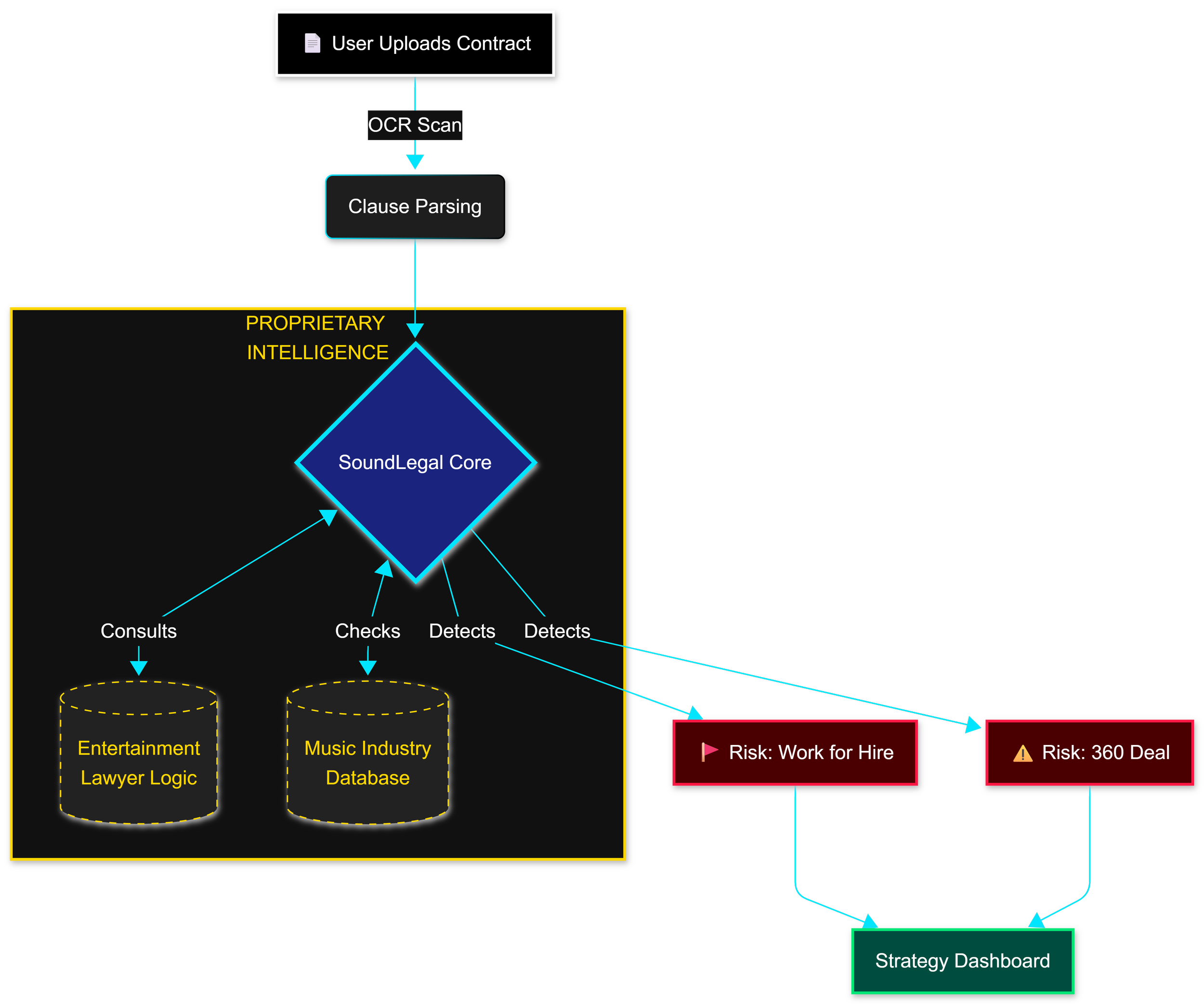
- Document Ingestion & Parsing: Users begin by uploading a contract (in PDF, DOC, or image form). The platform includes an ingestion module that handles OCR (Optical Character Recognition) for scanned documents and PDF parsing, converting the contract into text. The text is then segmented into logical sections or clauses.
- Clause Segmentation & Classification: The contract is automatically broken down clause-by-clause and each clause is classified by type (e.g. grant of rights, payment terms, exclusivity, etc.). This step uses a combination of regex rules and machine learning classifiers trained on entertainment contract data to identify important sections. By structuring the contract into digestible pieces, the system can apply targeted analysis to each part.
- Entertainment LLM Analysis: At the core of SoundLegal is a custom large language model, fine-tuned specifically on entertainment law text. This AI engine was initially built on a state-of-the-art LLM, then rigorously retrained on hundreds of real music and film contracts, legal annotations, and industry-specific terms. When a new contract is analyzed, the model processes each clause’s text along with its context (contract type, parties, etc.), and draws upon its specialized knowledge to interpret meaning and significance. Because the model was trained “a mile deep” on music law rather than a mile wide on generic internet text, it understands nuances like a “sunset clause” in a management deal (continuing post-termination commissions) or what “360 rights” entail, without needing explicit explanation. This domain focus yields higher accuracy on contract tasks – consistent with research showing legal-specific LLMs outperform general LLMs on nuanced legal understanding.
- Embedded Legal Logic & Knowledge Base: Beyond the pure neural model, SoundLegal embeds a layer of legal reasoning rules and a knowledge database. This includes a repository of common clause patterns, legal definitions, and best-practice checklists provided by entertainment attorneys. For example, if the model identifies a royalty clause, the system cross-references a knowledge base of typical royalty rates and audit rights. If a clause mentions “work for hire” or “in perpetuity”, the engine recognizes these as red-flag terms (from its rule-base) and triggers special handling to highlight risks. This hybrid approach – combining AI with coded expert logic – ensures that critical industry-specific issues are not only caught, but assessed in line with how a seasoned lawyer would approach them. The legal knowledge base is continuously updated; as new laws or industry contract standards emerge, SoundLegal’s developers (with legal experts) update the rules and training data, keeping the AI’s advice current.
- Output Synthesis & User Interface: Finally, SoundLegal synthesizes the analysis into human-friendly outputs. The system assembles a report that maps each original clause to a plain-English explanation and an actionable insight. Key terms (like rights granted, durations, royalty percentages) are extracted and presented in summaries or even in table form for clarity. Risky clauses are prepended with warning icons or labels (e.g. “⚠️ Work for Hire – You would waive future ownership of these recordings”) and specific recommendations (e.g. “Consider negotiating a termination provision or a royalty audit clause”). Crucially, the output is not just a dry summary, but a contextual advisory: SoundLegal will not only translate legalese, but also tell the user “what this means for you” and “what you might do about it”. The results are delivered via a web-based dashboard that is accessible to non-lawyers. Users can click on highlighted sections of the uploaded contract to see SoundLegal’s explanation side-by-side, or jump to a generated contract summary and Q&A section. This intuitive UX means that even a first-time user—say an indie musician with no legal background—can navigate their contract’s story with ease.
Performance and Scalability: SoundLegal’s architecture is optimized for instant analysis. By leveraging efficient text chunking and parallel processing, the platform can analyze a standard record deal (~20 pages) in under a minute, delivering near-real-time feedback to the user. The underlying AI model runs on cloud-based GPU servers for speed, and the vectorized knowledge retrieval ensures that even large contracts or libraries of contracts can be processed without slow-down. This engineering focus on responsive performance addresses a key need in the field: creators often have limited time to decide on deals, so an AI assistant must work on a human timescale (seconds or minutes, not days).
Importantly, while the above describes the system’s automated pipeline, SoundLegal’s design includes hooks for human review at critical junctures. For example, a particularly unusual or complex clause can be flagged for a “human check” if the AI’s confidence is low. In enterprise scenarios (e.g. a label or law firm using SoundLegal), a lawyer on the team can easily review and adjust the AI’s output via an editor interface, creating a feedback loop that further trains the model. Thus, the architecture isn’t a black box in isolation—it’s a collaborative AI, with human-in-the-loop integration at both training time and (if needed) during deployment.
Alongside analysis, SoundLegal includes an agreement authoring capability for drafting common entertainment agreements. The system collects structured deal inputs (parties, term, territory, rights scope, compensation, deliverables, approvals, termination, and dispute mechanics), composes a first-draft document using a curated clause library, then performs internal consistency validation (definitions, cross-references, dates, and conflicting terms). The draft is paired with a plain-English companion layer that explains each section’s purpose and typical negotiation levers, so creators can understand what they are proposing or signing before professional review.
Functional Modules & User Experience
From a user’s perspective, SoundLegal delivers a seamless experience that simplifies contract review into a few effortless steps. Below is a walkthrough of the platform’s key functional modules and how users interact with them:
- Upload & Input: The user (artist, manager, lawyer, etc.) logs into the SoundLegal web application. The interface immediately offers a prompt to upload a contract file or drag-and-drop it. SoundLegal accepts common formats (PDF, Word, text, and image scans). For instance, an independent musician can upload their new recording contract PDF. The platform then automatically handles text extraction (including OCR for scans) in the background.
- Instant AI Analysis: Once the document is uploaded, the user clicks “Analyze”. Within seconds, SoundLegal’s backend pipeline (described in the previous section) parses and analyzes the contract. The user is presented with an interactive analysis dashboard. This typically includes:
Summary of Key Terms: A top-level summary that outlines the deal in plain language...
Clause-by-Clause Insights: The contract text is displayed with important clauses automatically highlighted... - Risk Alerts and Recommendations: For any clause that could significantly impact the artist’s rights or income, SoundLegal places a “Risk Alert” indicator. These alerts are written in clear, urgent language, often accompanied by guidance. For instance: “⚠️ Exclusivity Clause: This contract prevents you from collaborating with other labels..."
- Negotiation Tips: In addition to flagging issues, SoundLegal often provides negotiation tips or alternatives. E.g., if a contract lacks a reversion clause for master recordings, SoundLegal might note: “No Reversion Clause: The contract does not specify if/when rights to your masters return to you..."
- Q&A Chat (Beta): For users who have follow-up questions, SoundLegal offers a chat-like interface where they can ask questions about the contract in natural language. For example, “Can the label sell my music to a movie without asking me?” The AI will refer to the sync licensing or rights clauses and answer accordingly.
- Visualization & Reports: Users can also view certain analytical visualizations. For example, a Royalty Breakdown table might be generated if the contract’s payment terms are complex. SoundLegal can also generate a summary report PDF.
- Build Mode: SoundLegal offers a dedicated Build mode for agreement creation. Users choose an agreement type, complete a guided intake, and receive a clean first draft plus an accompanying explanation layer.
- Collaboration & Expert Review: Understanding that some users will still consult human lawyers, SoundLegal includes features for expert collaboration. A user can invite their lawyer (or a trusted advisor) to view the contract analysis through a secure link.
- Continuous Learning Feedback: The UX also allows users to give feedback on the AI’s outputs. If SoundLegal flags something incorrectly or if an explanation is unclear, the user can mark it.
Overall, the usability is designed for non-lawyers. Every element – from the language used (“plain English,” no Latin or legalese) to the one-click upload and analyze flow – is crafted so that a creator can use SoundLegal without any training. Beta testers have described the experience as akin to having “a lawyer friend translating each paragraph as you read,” which is exactly the user experience SoundLegal strives for. By hiding the complex AI under the hood and surfacing only clear, actionable information, the platform turns contract review from a daunting chore into a straightforward, even empowering, exercise.
Domain Intelligence: Entertainment-Specific Model Design
The heart of SoundLegal’s competitive edge is its deep entertainment-law intelligence – the result of purpose-built data, models, and training processes that go far beyond a generic AI’s knowledge. Here we detail how SoundLegal’s AI brain was sculpted specifically for music and entertainment contracts:
- Proprietary Dataset of Contracts: SoundLegal has assembled a one-of-a-kind corpus of music and entertainment contracts. This includes hundreds of real “gold-standard” agreements – actual recording contracts, publishing deals, management agreements, licensing contracts, etc., contributed (in anonymized form) by industry veterans. Unlike public datasets or templates, these are the same contracts labels, publishers, and artists have signed in practice. By training on this trove, SoundLegal gains an innate familiarity with how deals are structured in the real world.
- Expert-Annotated and Lawyer-Trained: Raw data alone isn’t enough; human expertise is embedded at every stage. SoundLegal’s model was literally taught by top entertainment lawyers. Through a series of rigorous training sessions, these lawyers reviewed the AI’s outputs and fine-tuned its understanding. In practice, this meant employing techniques like Reinforcement Learning from Human Feedback (RLHF) and iterative prompt engineering with experts. Attorneys from major music capitals (Los Angeles, New York, London) provided feedback on model interpretations, ensuring the AI mirrors a consensus legal view.
- Continuous Domain Updates: The music and entertainment landscape is dynamic—new precedents, laws, and business models emerge regularly. SoundLegal is designed as a living system that keeps pace with these changes. The model’s knowledge base is regularly updated with recent case law, legislative changes, and evolving contract standards. If a new statute affecting record deals is passed in 2026, SoundLegal’s legal experts will incorporate that into the AI’s training or reference data, ensuring users get advice grounded in the latest reality, not last year’s information.
- Reduced Hallucinations and Higher Accuracy: A notorious problem with general AI models is hallucination – confidently generating incorrect facts or non-existent legal provisions. SoundLegal’s domain-specific approach mitigates this. Because the AI is constrained and focused on entertainment law, it doesn’t drift into areas it doesn’t understand. It has been fact-checked against actual law and contracts during development. If a user asks about a contract clause, SoundLegal either finds the answer in the contract or known legal principles, or it indicates that information is not determinable – it will not fabricate a fake “law” or precedent just to have an answer.
- Entertainment-Specific Language and Concepts: Music and entertainment contracts have idiosyncratic language. Terms like “master recording,” “sync license,” “360 deal,” “points” (meaning percentage points on royalties), or “pay-or-play” would confuse a general model (or be interpreted in a generic sense). SoundLegal’s model was explicitly taught these terms in context. It understands industry slang and shorthand. For instance, it knows that “X gets 3 points on the album” means X receives a 3% royalty on sales – something a general AI might never deduce from just the words.
In summary, SoundLegal’s AI isn’t an off-the-shelf model with a few music contracts thrown in; it is a custom-crafted legal intelligence for entertainment. By combining a rich proprietary dataset, direct training by legal experts, continuous updates, and a laser focus on industry vernacular and norms, SoundLegal achieves an expert level of comprehension. For the end user, this translates to analysis they can trust – the AI’s advice aligns with what a seasoned entertainment attorney would likely say in the same situation, because that attorney’s logic is literally embedded in the model. This robust domain foundation is what empowers SoundLegal to be the first AI legal assistant truly capable of navigating the entertainment world’s contractual minefields.
Ethical Guardrails and Human Oversight
Deploying an AI in the legal domain, especially one that guides real contractual decisions, demands a strong commitment to ethics and responsible design. SoundLegal AI is built with multiple ethical guardrails and human oversight mechanisms to ensure its advice is reliable, fair, and aligned with users’ best interests, while acknowledging the limitations of AI in legal contexts. Here are the key principles and measures in place:
- Not a Lawyer, But an Assistant: SoundLegal is positioned as a tool for information and insight, not as a substitute for licensed legal counsel. Throughout the user experience, the platform includes clear disclaimers that it is not providing legal advice in the formal sense, and that no attorney-client relationship is formed. Users are reminded that while SoundLegal can highlight issues and educate them, final decisions should be made with consideration of human legal advice for critical matters.
- Human-in-the-Loop Oversight: As discussed, human entertainment lawyers have been involved from the ground up in training the model. But the oversight doesn’t stop at training – it continues in deployment. SoundLegal maintains a system where if the AI encounters a novel or highly complex query that it’s uncertain about, it can flag for human review. The SoundLegal team includes legal experts who periodically audit the AI’s outputs (especially in the early stages) to ensure quality and correctness.
- Conservative Approach to Uncertainty: The AI is intentionally programmed to be conservative in the face of uncertainty. If it isn’t reasonably sure about an answer or interpretation, it will either refrain from answer or explicitly state uncertainty, rather than guess. For example, if a user asks, “Is this clause enforceable in court?” – something that often depends on jurisdiction and specifics – SoundLegal might respond: “Enforceability can depend on context and jurisdiction. This clause raises potential issues (X, Y), but a human attorney should review to give you a definitive answer.”
- No Hallucinated Laws or False Citations: SoundLegal’s outputs are grounded in its knowledge base. The system avoids citing specific case law or statutes unless they are explicitly in its database of verified legal sources. In contrast to some AI systems that might generate a plausible-sounding but fake case reference, SoundLegal either cites actual known authorities or none at all.
- Bias and Fairness Considerations: Entertainment contracts often reflect power imbalances (e.g. label vs artist). SoundLegal’s goal is to empower the weaker party (usually the creator) with information. In training, we took care to include perspectives from both sides – but with an eye towards flagging unfair terms. There is a conscious ethical stance: if a clause is heavily one-sided in favor of a company at an artist’s expense, SoundLegal will call it out.
- Privacy and Data Security: Contracts uploaded to SoundLegal often contain sensitive personal and business information. The platform adheres to strict privacy protocols. Uploaded documents are encrypted in transit and at rest. They are not used to further train the AI model unless explicit permission is given (and even then, any identifying details are removed). SoundLegal’s privacy policy commits that user contracts remain confidential.
- Regulatory Compliance: As AI in law is a nascent area, SoundLegal keeps a close watch on relevant regulations. The platform is built to be compliant with data protection laws (like GDPR) for users in applicable jurisdictions. If a user is in the EU and requests their data be deleted, SoundLegal can permanently erase their uploads and analysis records.
- Audit Trails and Transparency: Each analysis session in SoundLegal can generate an audit report showing how the AI arrived at its conclusions. Internally, the system can log which parts of a contract triggered which rules or model responses. If ever an output is questioned, this log can be reviewed to understand the AI’s reasoning path.
In designing SoundLegal, we recognized that trust is paramount. Creators might rely on this tool for important decisions, and investors/stakeholders will scrutinize its reliability and legality. Thus, ethics and oversight are not afterthoughts; they are deeply woven into the product. The involvement of human lawyers at multiple stages, the cautious approach to uncertain answers, and the robust privacy measures all serve one purpose: to make SoundLegal safe and trustworthy for public use. We want users to feel confident that while SoundLegal leverages cutting-edge AI, it does so in a way that respects the gravity of legal matters. As we scale, we will continue to invest in these guardrails—because pioneering the AI legal assistant space comes with the responsibility of setting the right precedent for ethical AI deployment.